Every product update costs you an hour of agent time. Multiply that by 200 references, 4 catalogue rotations per year, 3 markets. Your static FAQ is not a support tool. It is an operational sinkhole that renews itself every week.
Static FAQ: hidden costs and reality
There is a cost line that your finance director never sees. It does not appear in your analytics tools. It has no dedicated budget line. Yet it ties up between 20 and 30% of your support teams’ time every week. This hidden cost is the cost of manually maintaining your knowledge base.
A 2024 Gartner study on document management in retail puts a figure on the problem: maintaining a FAQ represents on average 23% of support teams’ time. Moreover, the finding is clear-cut:
- Zero sales generated.
- Zero tickets resolved.
This time is purely devoted to maintaining information that will be obsolete again in the short term.
In 2026, e-commerce retailers can no longer afford to “waste time” this way in an increasingly competitive market.
Why does your knowledge base cost you more than it earns you?
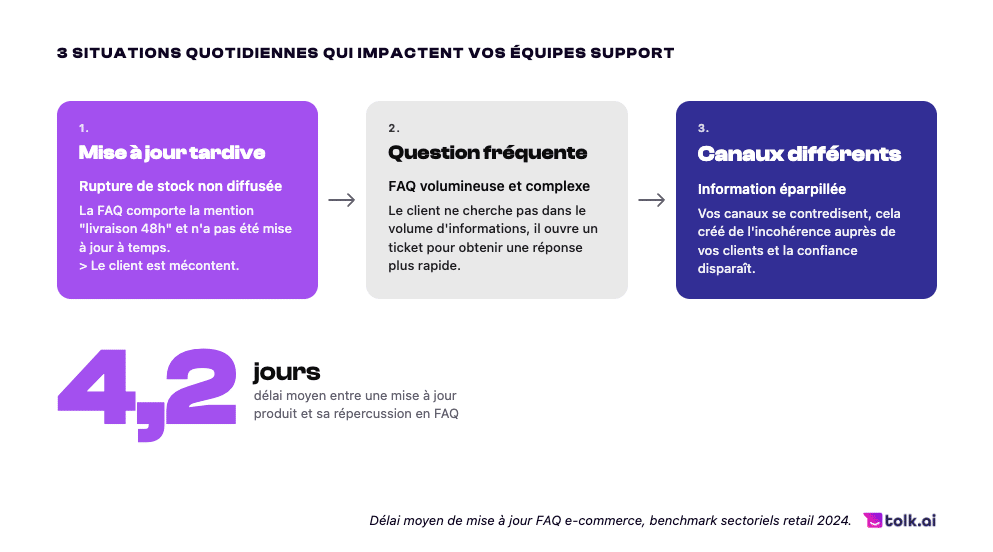
3 situations your support teams face regularly
1. The update that arrives too late
For example, a customer orders based on a delivery time displayed as “48h”. Your warehouse has been out of stock for 3 days. The information in your FAQ has not been updated. As a result, the customer is dissatisfied, this generates a ticket, a credit note and, on top of that, a 2-star rating out of 5.
Furthermore, the average time between an operational change and its update in an e-commerce FAQ is 4.2 days under normal conditions. Imagine during peak periods? Black Friday, sales, back-to-school and so on. This delay sometimes climbs to 8 days! Every day of lag is a source of predictable and, above all, avoidable customer service work.
2. The question that keeps coming back
In another scenario, your team receives the same 20 questions every week despite a complete and well-structured FAQ. This is not a visibility problem. It is a format problem.
Your visitors do not want to search for an answer. They want to receive it, at the precise moment the doubt arises, without leaving their purchase funnel.
Leaving a product page to read several FAQ sections is a friction that the 2026 consumer systematically refuses. They close the tab. You lose the sale.
3. The channels that contradict each other
A final example: your main FAQ states “returns within 30 days”. Your phone team’s script mentions “14 working days”. Your conventional chatbot, which has not been updated since the last training session, says “contact us”. In the end, you have three channels giving three different answers. As a consequence, the customer who moves from one to another receives contradictory information, and the perceived inconsistency breaks trust more effectively than a single wrong answer.
The problem worsens with growth
Unsurprisingly, maintaining a static knowledge base does not scale.
Worse still! It grows heavier in proportion to your catalogue, the number of markets, and the number of channels. For example, a retailer that doubles its number of SKUs* mechanically doubles its document maintenance workload, without doubling its support team in return.
* The stock keeping unit, also called consumer sales unit, comes from the English term SKU, which stands for “stock keeping unit”.
Moreover, the outcome is predictable: as you grow, your information becomes structurally less reliable. Not because your teams work less, but because the volume of updates required exceeds the human capacity to handle them in real time.
This is exactly the point on which the most advanced e-commerce retailers have changed their approach in order to perform.
Moving from a static FAQ to a dynamic knowledge base
To perform in an ultra-competitive market, you have to innovate.
The e-commerce sites that have solved this problem did not necessarily have to make a huge effort. They simply connected their customer relationship tool directly to their operational data sources. Product catalogue, real-time stock, commercial policy, order history and so on: everything is now up to date effortlessly.
To do this, most now turn to agentic AI through conversational agents.
For example, when your return policy changes in your ERP*, all your AI agent’s answers update within the same minute. In conclusion, zero delay, zero human intervention, zero risk of inconsistency between channels.
* The acronym ERP stands for Enterprise Resource Planning, software for planning a company’s resources.
What is more, the gain is not only operational. It is a measurable gain in customer trust:
- -40% customer service tickets linked to incorrect or outdated product information (e-commerce AI benchmarks 2025, aggregated data);
- -80% support time devoted to document updates;
- Full consistency across site, app, marketplace and email, with no synchronisation effort.
Ultimately, high-performing e-commerce retailers do invest in an AI agent, of course, but they now manage to make the difference thanks to a major competitive advantage. The agents allow them to reassure their visitors, trigger the act of purchase, address customer objections or relieve the support teams, and so on.
Frozen static FAQ or dynamic catalogue: the answer is obvious.
To conclude, the real cost of a static knowledge base is not the time spent building it. It is the time spent maintaining it, multiplied by the number of channels, in turn multiplied by the velocity of your catalogue.
The retailers that move to dynamic knowledge through artificial intelligence in 2026 will not only have reduced their operational costs. They will have turned their product information into a competitive advantage: accurate, instant, and consistent across all their touchpoints.
In our next article, we will look in detail at the definition of proactive AI and how your site can engage your visitor before they leave.
Useful resources
- Gartner, Knowledge Management in Customer Service, 2024
- FEVAD, e-commerce barometer 2024
In the previous article, we addressed the topic of “invisible” cart abandonment in the e-commerce sector and its impact on web visitors.