In our previous article, we showed why static knowledge bases become an operational drain as your catalog grows. Today, we go one step further: rather than waiting for your visitors to ask a question, what would happen if your AI took the initiative in the conversation at the right moment?
Your chat button is available around the clock. Fewer than 3% of your visitors open it. What if your AI spoke first?
Proactive AI: the illusion of available chat
On average, a visitor spends 4 minutes on your product page. They scroll, return to the technical specifications, open and close the size selector. Then they close the tab.
In your analytics, you will see: a 4-minute session, a bounce rate of 0, no purchase. The standard reading of this kind of data is often: an engaged visitor who did not convert. The reality, however, is quite different. A buyer had a specific question, did not ask it, and left to find the answer elsewhere.
This behavior accounts for 60 to 70% of your qualified traffic on high-traffic pages (aggregated e-commerce artificial intelligence benchmark data, 2025). This is not indecision, it is silent hesitation, and it costs you sales every day.
Wait or anticipate: the only real question
Passive chat relies on a simple assistance reflex: if you need help, I am here. This model was enough when e-commerce sites were less mature and the competition less aggressive. It is no longer enough today, when your competitor engages the visitor the moment the first hesitation is detected.
Proactive artificial intelligence completely reverses this logic. Rather than waiting, it observes behavioral signals in real time, identifies moments of friction, and steps in with the right message at the right time. This is not an intrusive pop-in that disrupts navigation. It is a contextual, discreet suggestion, triggered solely by the visitor’s own behavior.
Thus, a visitor who scrolls through the same technical section three times needs a precise answer on a point that is blocking them. Proactive AI detects this and naturally opens the conversation, without friction.
The four behavioral signals your website ignores today
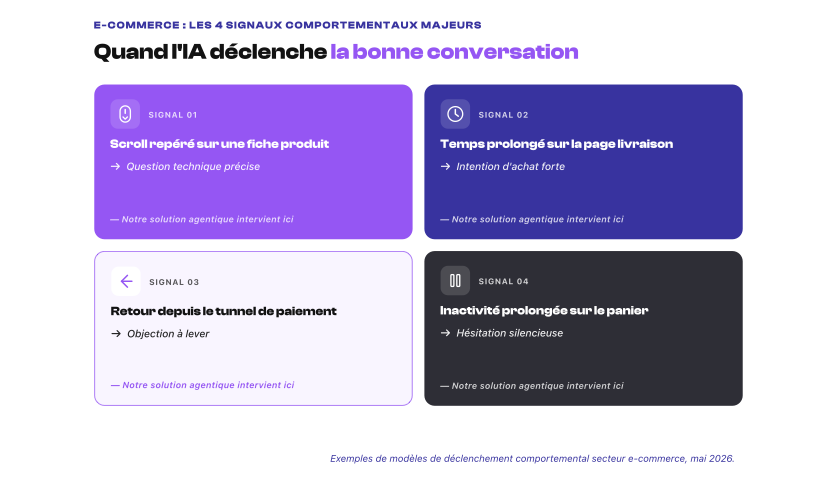
By the way, your website already constantly generates very valuable behavioral data, yet no standard tool uses it to trigger a conversation. Here are the four most revealing signals.
1. Repeated scrolling on a specific area
When a visitor returns several times to the same section of a page, it means they are looking for information the page does not give them clearly. Once captured by the AI, this signal makes it possible to open a targeted and relevant conversation: “Are you looking for specific information about the dimensions? I can help you.” This intervention turns silent frustration into dialogue.
2. Time spent on the delivery page
A visitor who consults your delivery terms from a product page is, in the vast majority of cases, two questions away from an order. The duration of this visit is a strong purchase-intent indicator that your analytics tool carefully records, but does not use to trigger an action.
3. The return from the checkout funnel
When a visitor returns to a product page after starting a purchase, it is a sign they have a specific objection, often easy to resolve. Without a proactive intervention on your part, this objection goes unanswered and the order is never completed. Yet it is one of the signals that converts most easily.
4. Prolonged inactivity on a high-potential page
Finally, several seconds without interaction on a page with a high average basket is a clear signal of hesitation. This is precisely the moment to step in, without waiting for the visitor to leave.
Proactive AI, what impact?
Deployments of proactive AI on e-commerce sites with extensive catalogs show consistent and reproducible results.
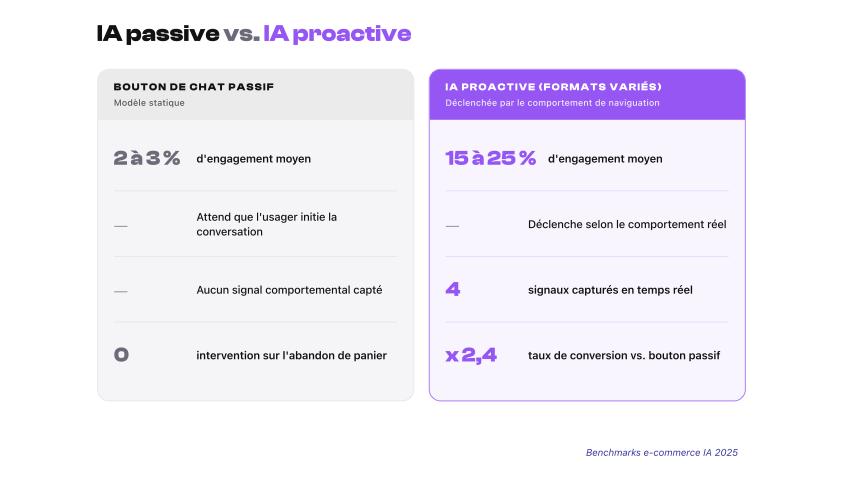
Indeed, the conversational engagement rate rises from 2 or 3% to 15 or 25% when the initiative comes from the AI rather than the visitor. The friction of the first step disappears completely. Furthermore, the conversion rate on sessions that involved an interaction with the AI is 2.4 times higher than that of sessions without interaction, all other things being equal (Forrester, 2024).
Finally, the average basket increases by 15 to 20% on sessions where the AI was able to overcome an objection or recommend a suitable complementary product.
These figures do not depend on the quality of your catalog or the level of your prices. They depend solely on the right timing and the relevance of the intervention.
Engage your visitors with proactive AI
In conclusion, proactive AI is not just an engagement gimmick. It is a layer of behavioral intelligence that turns the traffic you already have into conversation opportunities you were not capturing.
In our next article, we will introduce Genii, the agentic AI orchestration engine from tolk.ai, and how it has enabled e-merchants to increase their conversion rate quickly.
Sources
In the previous article, we highlighted the cost of a static FAQ and what it really yields: both for you and for your visitors.