Why do 80% of your visitors leave your site without buying, not for lack of interest, but for lack of an immediate answer about the product or stock? A breakdown of the invisible cart abandonment phenomenon.
80%
of visitors leave without buying,
even with a purchase intent
7 seconds
the maximum delay before a visitor gives up if they do not find their answer.
The illusion of the conversion rate
In the e-commerce sector, the performance analysis of a website rests on two axes. First, the visitors who buy, and then those who abandon their cart at the point of payment. However, there is a far broader and more costly “grey area”: invisible cart abandonment.
There is a type of abandonment that Google Analytics does not capture. The kind your heatmap does not visualize. The data your CX team never sees. It is the abandonment that arises from a simple question left unanswered. We call it: “invisible” cart abandonment.
1. A figure that hurts: 80% of silence
Sector studies for 2026 are unequivocal: 80% of users who have a doubt during an online purchase will never contact customer service. Why? Because in the mind of the modern consumer, if the answer is not immediate, the alternative is not the “contact form”, it is the competition. The silence of your site is interpreted as an insurmountable friction.
A scenario you never see
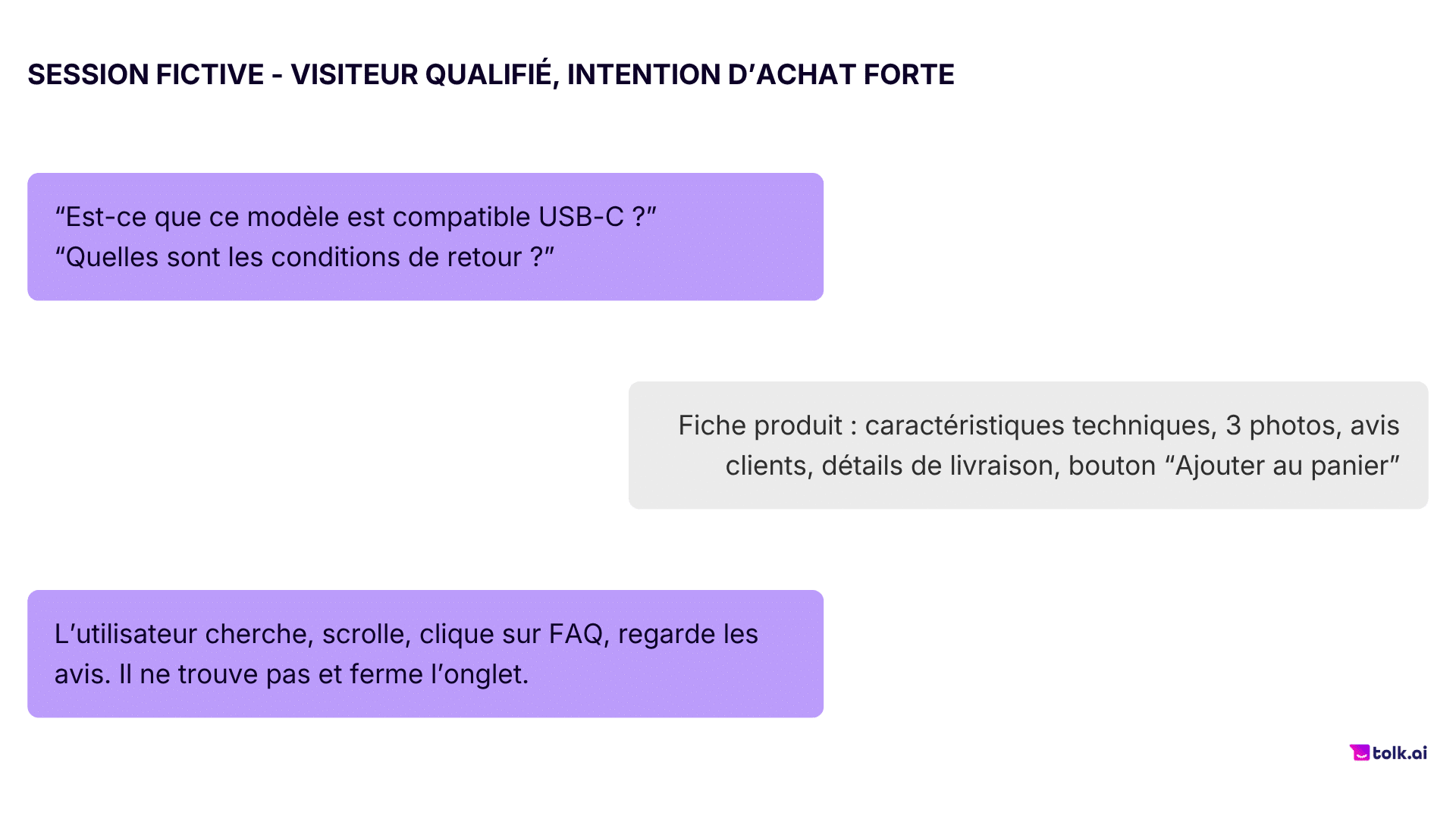
In your dashboard: a session of 2 min 18 s, bounce rate of 1, 0 revenue. Analytics diagnosis: “unqualified visitor”. Reality: a customer ready to buy, lost in 7 seconds.
Invisible abandonment is not a problem of price or friction. It is a problem of information not delivered at the right moment.
Anatomy of an abandonment that your tools ignore
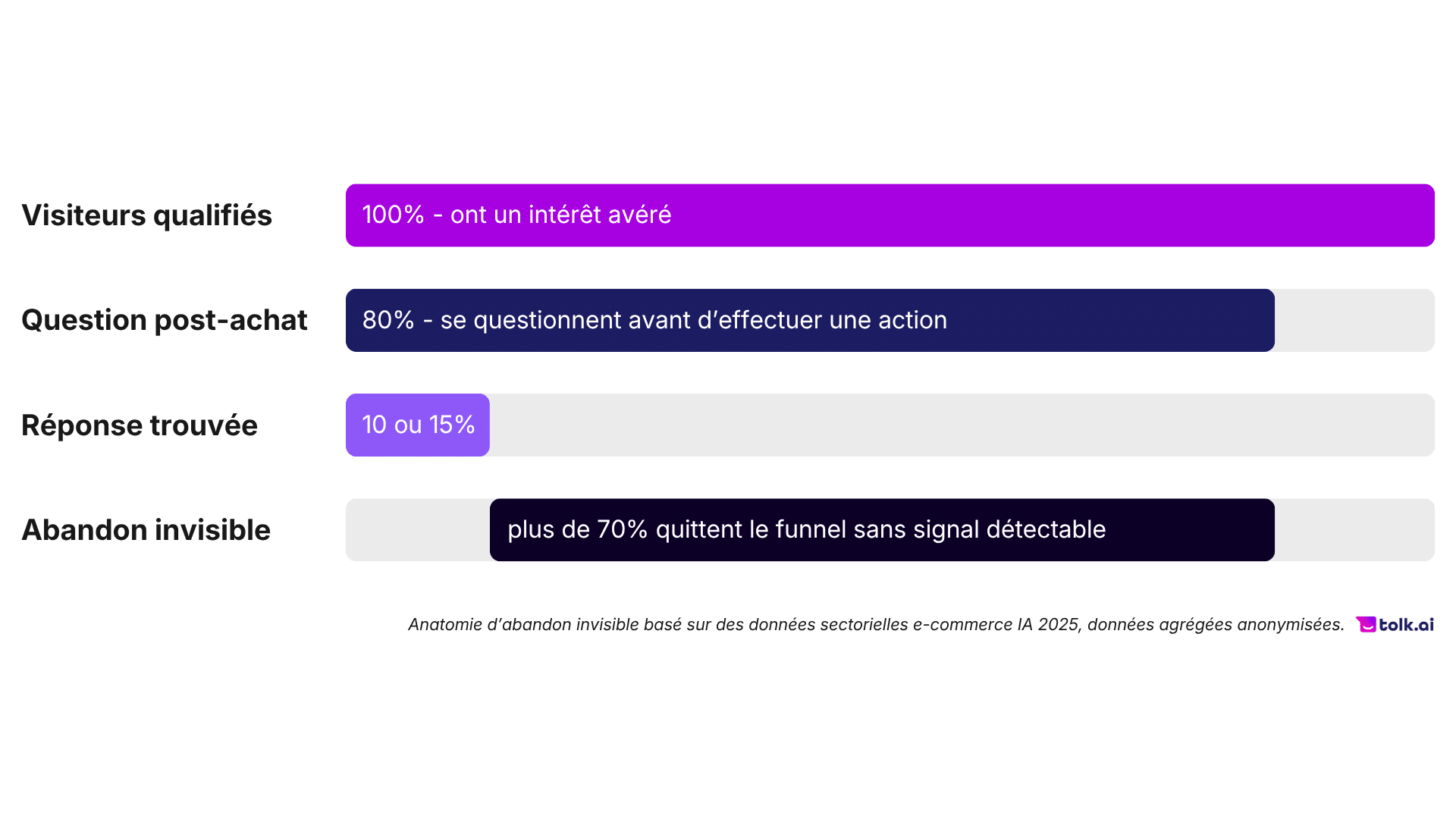
This funnel appears in no standard report. Yet this is where a major part of your lost revenue is decided. And the cause is systemic: your product pages are designed to display, not to answer.
2. The diagnosis: why do your current tools fail?
If you already have a chatbot or a FAQ, you think you are covered. It is often the opposite.
- The “Legacy” chatbot (or button-based chatbot): It relies on predictable keywords. If it does not recognize the exact syntax of the customer, it replies “Sorry, I did not understand your question”. This answer is worse than no answer at all: it confirms to the customer that your service is automated and ineffective.
- The static FAQ: Asking a customer to leave their purchase funnel to read a 2,000-word page is a strategic mistake. No one wants to “search” for information; everyone wants to “receive” an answer.
3. The break: the emergence of agentic AI
The difference between 2025 and 2026 comes down to one word: agenticity.
Unlike generic models that merely “chat”, agentic AI is capable of understanding intent and consulting your data in real time.
- Contextual understanding: If a customer asks “Is this lamp suitable for a baby’s room?”, the AI does not look for the word “baby”. It analyzes the materials, the product’s safety standards and the light intensity to give expert advice.
- Surgical precision: It does not guess, it knows. It is plugged directly into your product catalog and your stock, known as the “knowledge base”.
The agentic agent is not a support channel. It is a revenue lever operating at the most critical moment of the purchase journey.
4. The business impact: secured conversions
+23%
conversion rate
– 40%
in post-purchase support tickets
+ 18%
average cart value
Sources: e-commerce AI sector benchmarks 2025, aggregated anonymized data.
Customer support should no longer be seen as a cost center (handling complaints), but as a revenue accelerator. By removing doubt at the precise moment it appears, agentic AI turns an “exit intent” into a “purchase confirmation”. On high average carts or technical products, this impact can represent an increase of 30% in the net conversion rate.
Reducing invisible cart abandonment
Your product pages speak to everyone, an AI agent answers each individual
In conclusion, invisible abandonment is a problem of precision, not of volume. You do not need more traffic. You need the qualified visitors you already pay to attract to get an answer at the right moment, in the right context, in real time.
The decision-makers who integrate an agentic conversational agent in 2026 will not be playing on the same field as the others. They will have turned their invisible funnel into a measurable pipeline.
In our next article, we will explore the “hidden cost” of maintaining knowledge bases: why the manual management of your FAQs is your biggest operational obstacle.