In our previous article, we showed how proactive AI detects the silent hesitations of your visitors and steps in at the right moment.
Today, we move from theory to practice. What are the results of Genii deployments on e-commerce sites with extensive catalogs? And why are these results not tied solely to the size of the catalog or to prices?
Moreover, across all the e-commerce deployments observed in 2025, three results recur consistently, whatever the type of product involved.
What the deployment data reveals
First, the lesson is counterintuitive. Indeed, the sites that record the largest gains are not necessarily the ones that had the lowest conversion rates to begin with.
The best-performing sites are those whose qualified traffic was the highest. In other words, those that were losing the most in absolute value because of the silent hesitation of their visitors.
In other words, the better your traffic, the greater the potential gain.
1. Conversion: a systematic impact, not an anecdotal one
First, on sessions that involved an interaction with Genii, the conversion rate is 2.4 times higher on average than sessions without an interaction. This figure is consistent with what our AI experts observe at our e-commerce clients and across very different catalogs (from sports and outdoor to electronics, home and textiles).
The reason is therefore structural. A qualified visitor who does not get an answer to their specific question does not order. They do not leave because the product does not suit them. They leave the site because no one was there to answer at the right moment.
On the contrary, this is where proactive AI corrects that flaw without changing the catalog, without reworking product pages and without increasing the marketing budget.
AI deployments on e-commerce sites also show conversational engagement rates rising from 2 to 3% in classic widget mode to 15 to 25% when the AI takes the initiative in the conversation. The friction of the first step, the one that stops most visitors from opening a chat, disappears completely.
2. Average basket: contextual recommendation as a lever
Next, the second result observed consistently concerns the impact on the average basket. On sessions where Genii was able to make a contextual recommendation, the average basket rises by 15 to 20%. This is explained by the very nature of the interaction: an AI agent benefiting from the conversational context can recommend a compatible accessory, steer toward a reference better suited to the stated profile, or flag an offer consistent with the purchase intent.
Furthermore, this recommendation is not generic. It is anchored on catalog data in real time: available stock, technical compatibility, the commercial policy of the moment and so on. This is precisely what sets it apart from algorithmic recommendation engines, which operate without conversational context.
3. Customer service: an often-underestimated side effect
Lastly, one of the results is the one that e-commerce leadership anticipates the least. On sites with a high volume of customer service tickets, AI experts observe a reduction of 25 to 35% in incoming calls related to frequent or technical questions.
The explanation is simple: Genii answers from operational data in real time (catalog, stock, commercial policy, return conditions). As a result, it cannot pass on outdated information. The reduction in customer service volume is therefore not a direct objective of the deployment: it is a mechanical consequence of the accuracy of the answers delivered at the moment of purchase and afterward.
Concretely, a visitor who receives correct information on delivery time before ordering does not generate a customer service ticket for a missed deadline after ordering. Prevention happens upstream, in the conversation. Likewise, a visitor who can get an instant answer on a Sunday morning about their order tracking will not contact customer service on Monday.
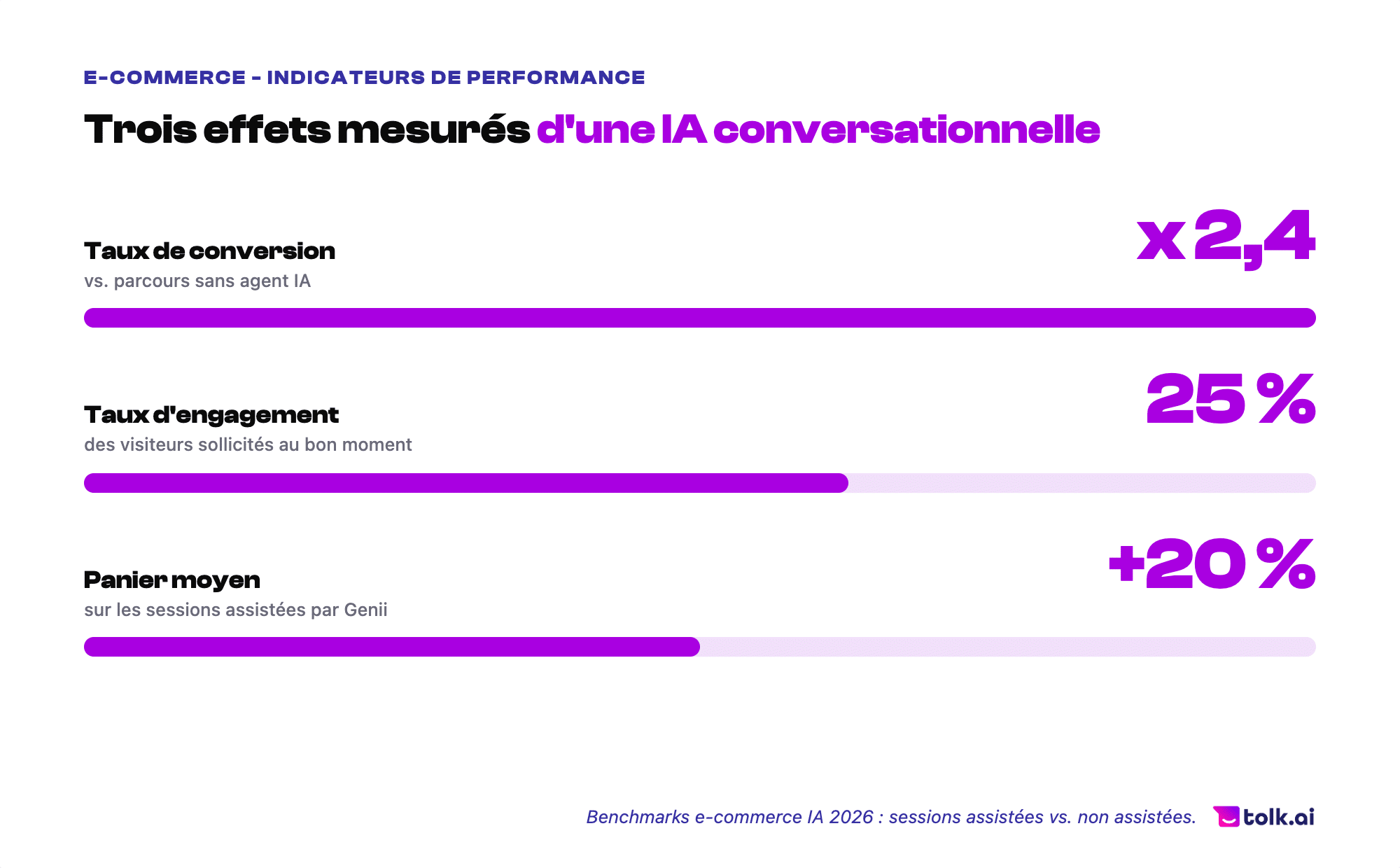
On e-commerce sites deploying Genii, three results emerge consistently: a significant rise in the conversion rate, an increase in the average basket through contextual recommendation, and a reduction in customer service contacts that follows mechanically from the quality of the answers delivered before purchase.
4. Can the technical complexity of an AI project affect its effectiveness?
Finally, one of the most frequent barriers to adopting conversational AI in e-commerce is neither cost nor technology. It is the time to production. A project that unfolds over several weeks will always be postponed in the face of the operational priorities of the moment, whether a catalog overhaul, a seasonal campaign or a platform migration.
The challenge is therefore to have a fast and easy deployment project. With tolk.ai, deployments can be operational in 4 business days on average*, from the test review to going into production. The connection to catalog data, real-time stock and the commercial policy is carried out through the native connectors of tolk.ai, with no specific development. Thus, this velocity fundamentally changes the decision-making equation. It becomes possible to test on a limited scope, to measure the real impact before the end of the month, and to scale only if the results are there.
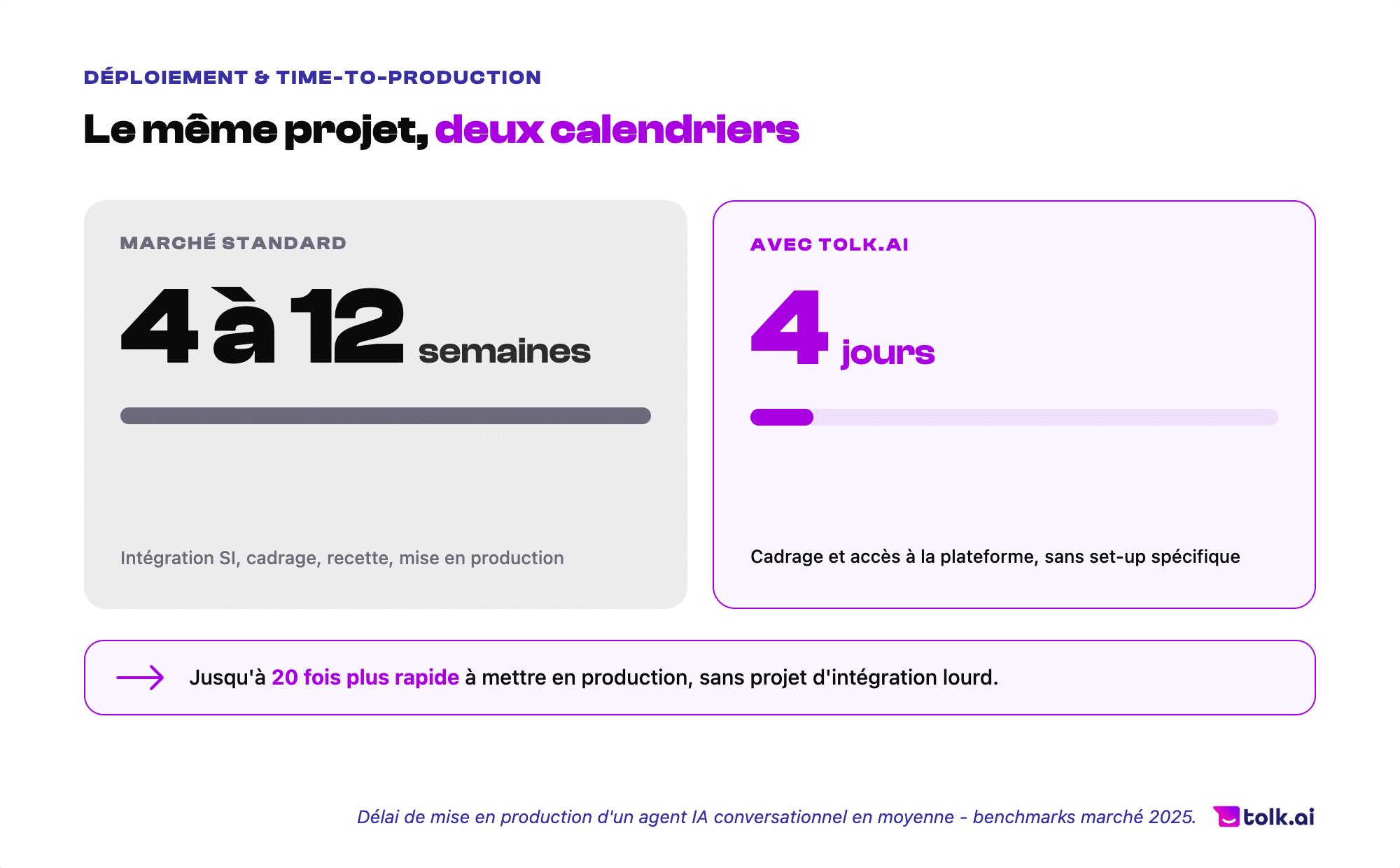
*The average time to production is based on classic pre-sales use cases. For any other use cases, the timeframe may vary.
Summary
To conclude, the deployments of the Genii solution at e-commerce players demonstrate that untapped conversion potential is not in the catalog. It lies in the space between purchase intent and the final decision, where qualified visitors ask questions that no one hears.
Our experts support you in auditing your friction points in order to identify the use cases to deploy first on your site.
Sources
Fédération du e-commerce et de la vente à distance (FEVAD). (2024). Bilan du e-commerce en France 2024. https://www.fevad.com
tolk.ai. (2025). Aggregated data from Genii e-commerce deployments, 2025. Anonymized internal data.