In 2026, fewer than 4% of French public websites comply with the RGAA (General Accessibility Improvement Framework). This figure is not a delay, it is legal exposure that your legal department should already have escalated.
The illusion of the “digitized” public service
Dematerialization is advancing. According to the “Services Publics+” program, 250 priority procedures are now available online. Digital transformation departments display reassuring green dashboards. And yet, 1 in 4 French citizens reports having given up on an administrative procedure online because they were unable to complete it (Baromètre du numérique 2024, CREDOC/ANCT).
There is a type of exclusion that your data does not capture. The kind that arises not from a technical bug, but from an incomprehensible interface, an untagged PDF form, a frequently asked questions (FAQ) page that cannot be found at 10 p.m. We call it: the digital silence of the public service.
Digital accessibility: what your tools ignore
This is not a traffic problem. It is a problem of real accessibility and, from now on, a legal problem.
1. Compliance: only 4% meet the RGAA
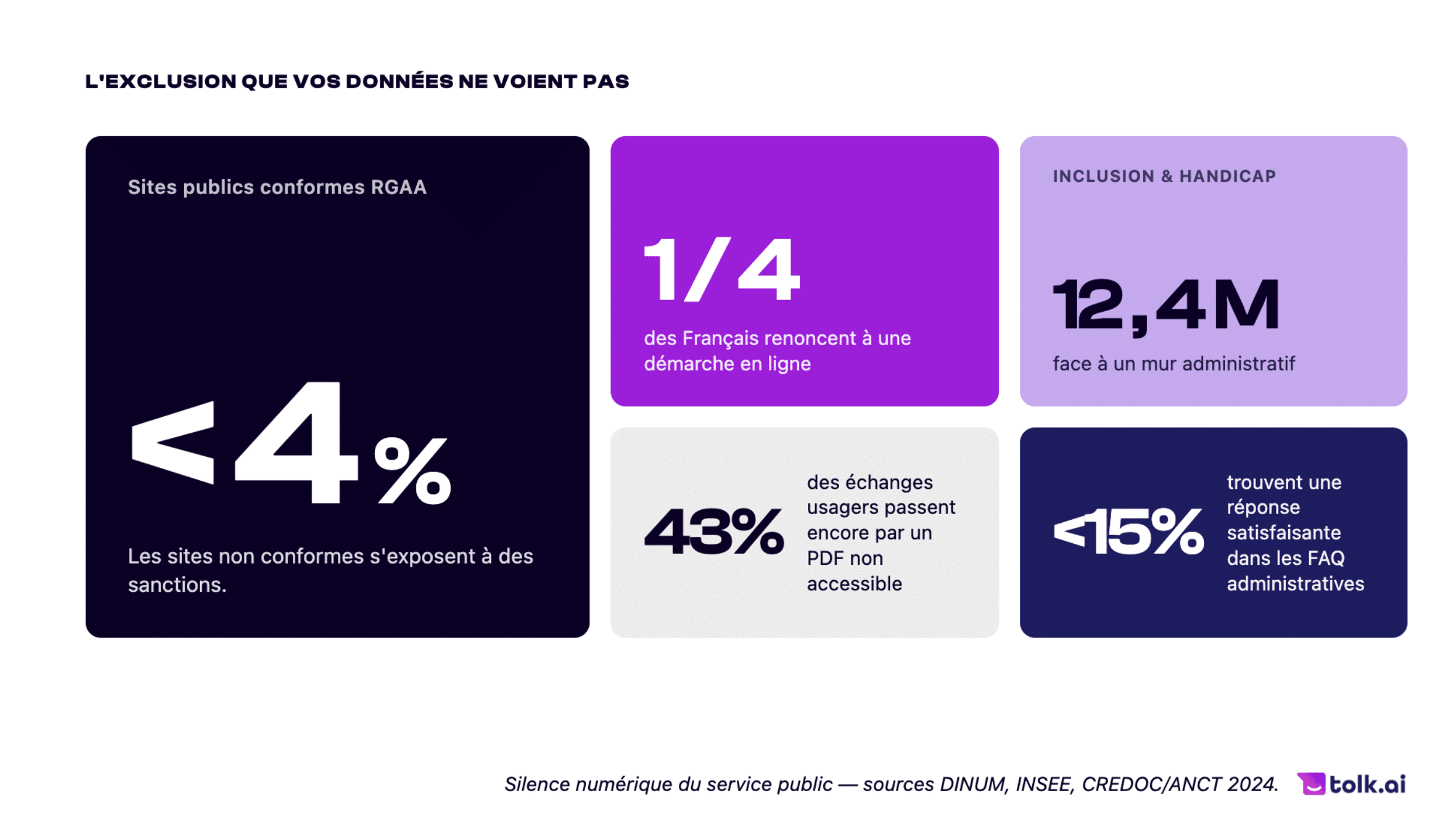
Fewer than 4% of French public websites are fully compliant with the General Accessibility Improvement Framework (RGAA) (source DINUM, 2024). In addition, 67% of dematerialized procedures present at least one major accessibility barrier.
For example, on a website dashboard you might read: completion rate of 61% or 39% drop-offs.
The standard diagnosis is “navigation path to be optimized”.
In reality, 12 million French citizens living with a disability are facing a wall that is legally prohibited. Most of them sometimes land on websites that cannot answer them.
Powerless, they abandon their online procedures and remain frustrated or excluded. These “drop-offs” visible in web data are not an ergonomics problem.
They are a matter of a legal obligation that is not being met.
2. Analysis: a paradoxical inclusion
As a result, this non-compliance leads to the exclusion of several profiles, within a framework that nonetheless aims to support digital accessibility, such as the RGAA.
Among these profiles, we can identify:
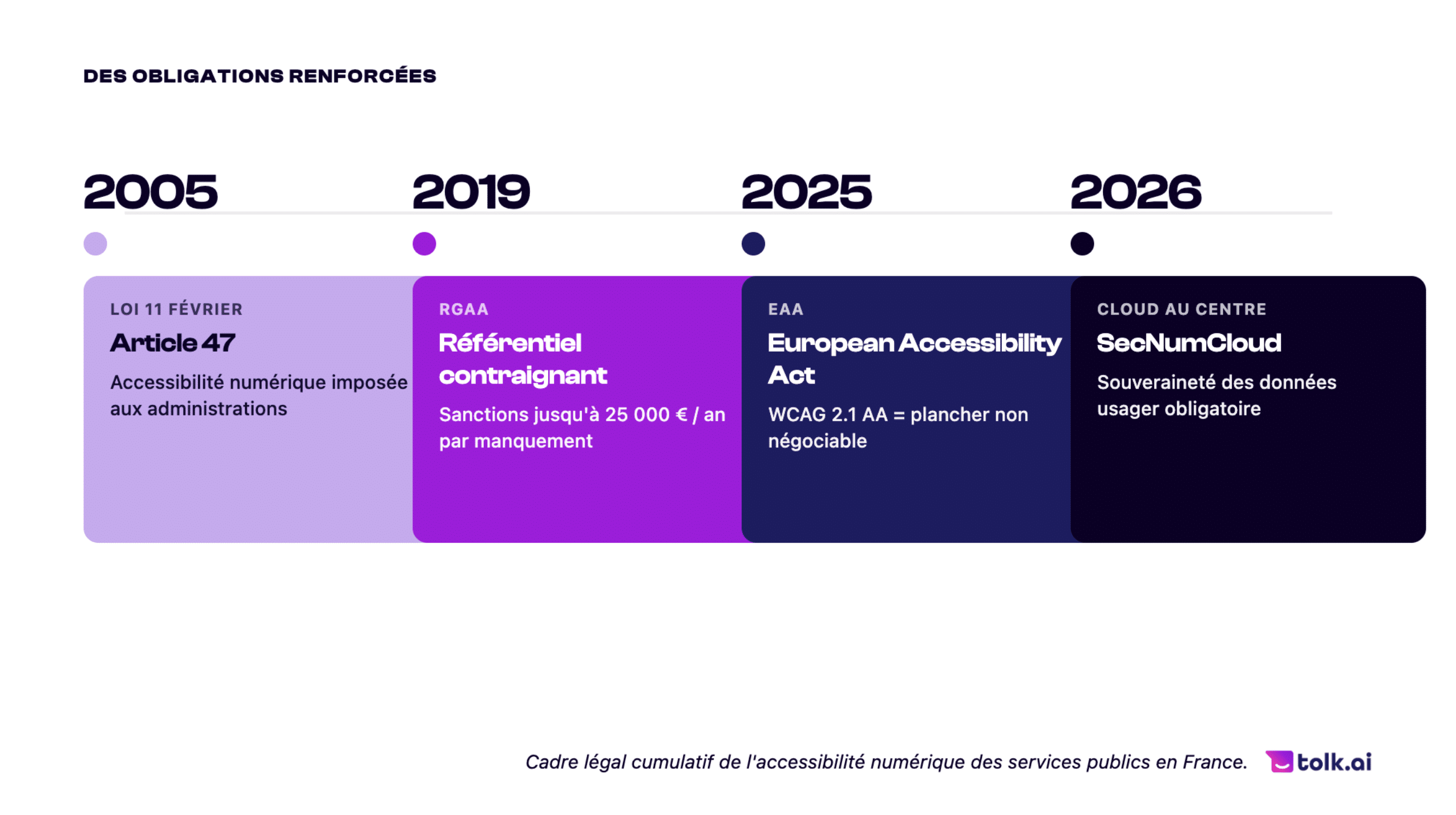
- People living with a disability, i.e. 12.4 million (INSEE 2023). Common issues include PDF forms not tagged for screen readers, videos without subtitles, and visual CAPTCHAs: each non-compliant component is a barrier legally prohibited by Article 47 of the law of 11 February 2005.
- Seniors, 38% of people over 75 have never used the internet (Baromètre du numérique 2024). When they do venture online, complex interfaces and administrative jargon generate massive drop-offs, followed by a phone call that overloads your reception services.
- Non-French speakers, i.e. 4 million non-French-speaking residents in France. For them, the most critical procedures concern residence permits, asylum applications, school enrollment and so on. These are almost exclusively available in French. The lack of multilingualism is, in the end, not a technical gap: it is a barrier to access to rights.
The impact for the public sector
3. Regulatory impact
For a public administration, ignorance or non-compliance with these rules is highly penalizing. Indeed, several texts provide for sanctions that can easily be avoided.
First, the RGAA should not be regarded as a framework of good practices. It is a binding legal obligation for all administrations, local authorities and public bodies. Sanctions reach up to 25,000 euros per year per breach, and the DINUM is strengthening its monitoring capabilities.
In addition, the European Accessibility Act, which came into force in June 2025, sets the WCAG* 2.1 AA level as the non-negotiable minimum for all European digital public services. This is no longer a target, it is the minimum floor.
*The Web Content Accessibility Guidelines (WCAG) are the most important guidelines when it comes to web accessibility policy.
Finally, the SGDSN’s “Cloud au Centre” doctrine requires that all data exchanged between a user and a public service remain on sovereign infrastructure qualified as SecNumCloud. Solutions that do not comply with this framework may not be selected in public tenders.
4. Operational impact
If you already have a FAQ and a phone number, you may think you have covered your obligations. Unfortunately, that is rarely enough.
Fewer than 15% of users find a satisfactory answer in the FAQs of administrative websites (ANCT 2023). The FAQ answers yesterday’s questions, not today’s. Updating it is costly, delegated to overloaded staff, and its actual consultation rate remains marginal.
Likewise, the inaccessible PDF form still accounts for 43% of exchanges between users and administrations (DINUM 2024). Not tagged for screen readers, it is the first obstacle reported by associations fighting against the exclusion of people living with a disability.
Finally, the call center is available from 9 a.m. to 5 p.m. The user, however, needs answers at any time: at 8 p.m. or on weekends.
The 2026 standard: 4 key dimensions
Ultimately, the most advanced administrations have integrated a simple reality: 24/7 accessibility is no longer an ambition, it is a selection criterion for solutions in calls for tenders.
Among the key criteria are:
- Permanent availability: an answer at any time, without waiting. Staff focus on complex situations; level 1 is 90% automated.
- Native multilingualism: not just a translation of the home page. The solution must be able to respond in the user’s language, with the same precision as in French. This is a systematic criterion for prefectures, the CAF (Family Allowance Fund) and consular services, for example.
- DSFR & RGAA compliance by design: no after-the-fact checks. Interface components must natively comply with the specifications of the French State Design System (DSFR) to be selected.
- Data sovereignty: any data exchanged with a user must remain on French soil. In addition, the doctrine also calls for directing data toward infrastructure qualified as SecNumCloud, beyond the reach of the American Cloud Act.
Your public service is open 24/7. Your support, however, is not.
In conclusion, the local authorities and administrations that integrate these four dimensions into their next tenders will not merely comply with the law. They will turn their relationship with users into a standard of trust: measurable, auditable and sovereign.
In our next article, we will explore the concrete impact of the Cloud Act on the data of French administrations, and why the Cloud au Centre doctrine is now an argument for trust, not only a technical imperative linked to AI.