The average e-commerce cart abandonment rate exceeds 70%. Most of the time, price is not what drives the buyer away. It is an unanswered question, an imperceptible friction, that is enough to break the purchase intent. Sparks was designed to intercept these silent hesitations before they turn into abandonments.
The real problem: customer effort holds back conversion
Chatbots and AI agents solved a real problem, that of availability. A customer service accessible 24/7, without mobilizing human agents, represents a concrete advance for online retailers. But it has not solved the central problem of conversion. Reassuring customers at the key moments of the purchase funnel.
For a chat widget to play its role, three conditions must be met:
- the customer must notice it,
- decide to open it and manage to do so,
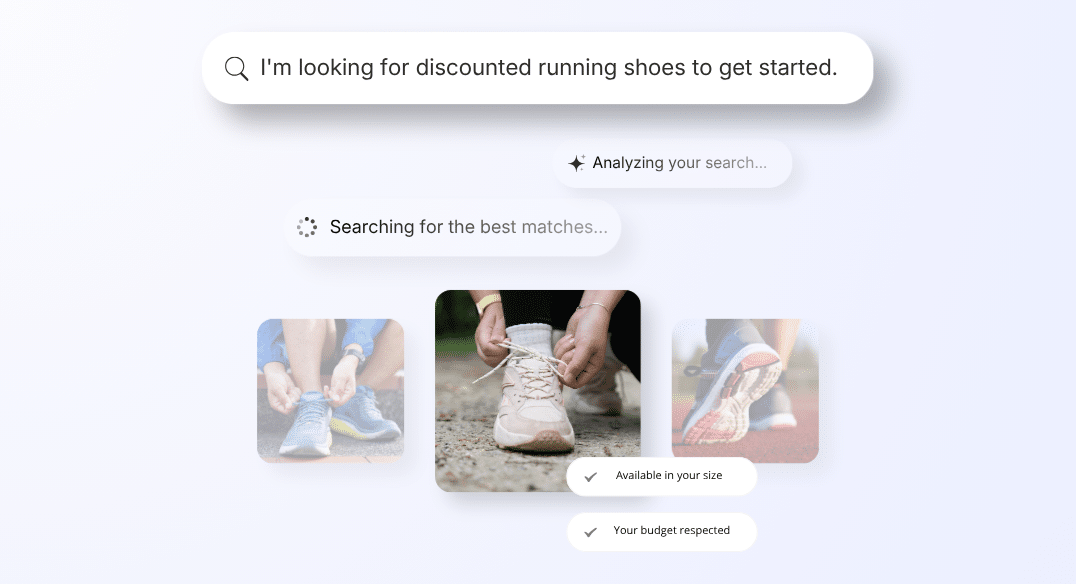
- then finally phrase the question as well as possible to get a relevant answer.
Three successive steps, at the precise moment when their attention is already taken up by a purchase decision. In practice, fewer than 5% of visitors spontaneously interact with a standard widget (Baymard Institute, 2024).
The remaining 95% leave the page without a trace, without adding to the cart, and without expressing the friction that made them leave.
This is not a problem of visibility or design. It is a structural limitation: a classic chatbot (accessible from the bubble in the bottom right of your interface) is designed to answer, not to convert. It waits. And in e-commerce, waiting costs sales.
10 seconds to reassure or lose the sale
First, let us take a concrete scenario, the one your customers live through dozens of times a day on your product pages. A potential buyer hesitates over the size of a pair of sneakers, the compatibility of an accessory with their equipment, or the return conditions of an item.
This question, they do not phrase. They quickly scan the product page looking for an immediate answer. If the information does not come within the first few seconds, the customer leaves, often to a competitor.
A study establishes that the attention window on a product page is 10 seconds at most before an abandonment signal is triggered. Customer reviews, detailed descriptions, size guides: few buyers take the time to read them in full.
Furthermore, friction is not always visible. It is often cognitive, an unresolved hesitation is enough to block the add to cart.
In addition, a passive chat widget only half answers this problem. Triggered only when the customer reaches out, its activation rate fluctuates between 2 and 5% of visitors. Finally, a vast silent majority leaves without having interacted and without having converted. This majority also left no usable data on the nature of their friction.
Ultimately, customer effort is at the center of the conversion process.
Sparks: native reassurance, inside your product page
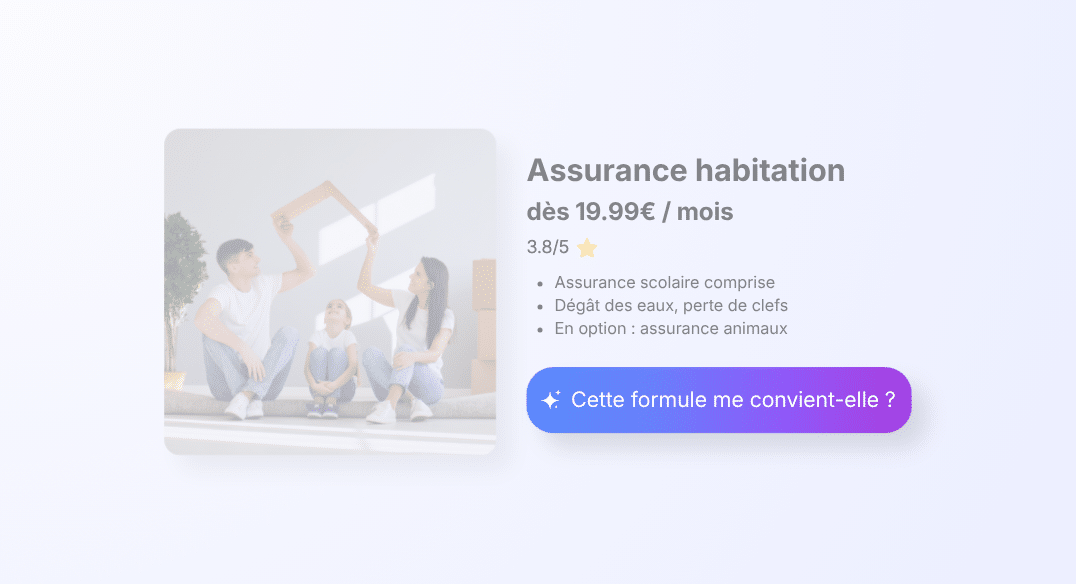
Thus, Sparks is the perfect answer to this observation. Rather than waiting for the buyer to phrase a question, Sparks analyzes in real time the content of every product page viewed: customer reviews, technical specifications, compatibility, and also draws on questions already asked and their frequency.
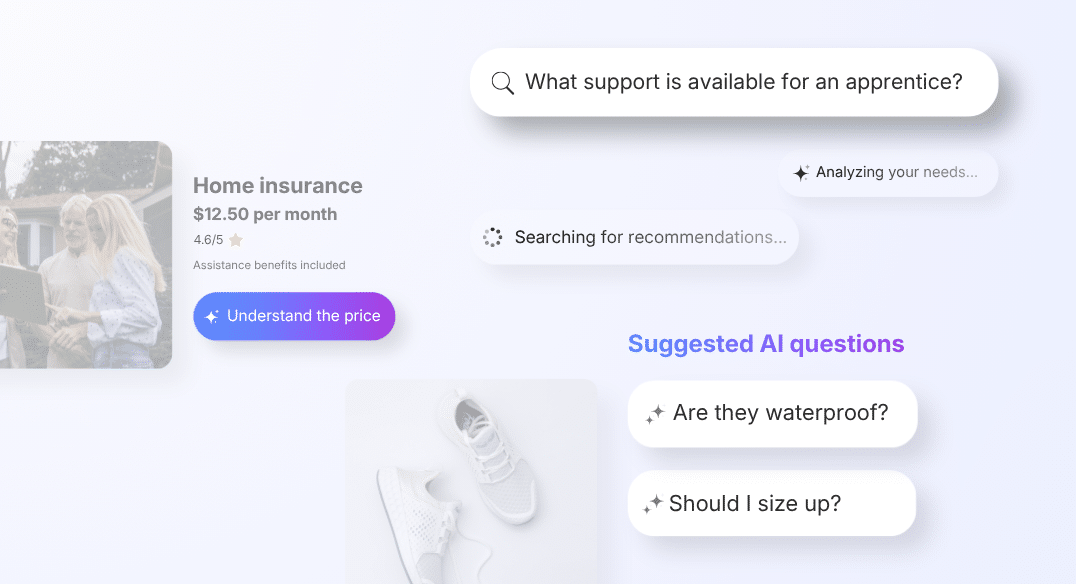
Coupled with the conversational intelligence of Genii, Sparks generates the most likely questions this buyer would have asked, and displays them directly in the product page, as clickable suggestions, without requiring any prior effort on their part.

 Virtual assistant
Click a question to simulate a Sparks interaction
No effort required from the customer. Sparks anticipates the question and answers it directly, in a personalized and contextualized way. The customer only has to resume their path to the add to cart. It is precisely this mechanism that acts on your conversion rate. Where the passive AI agent fails.
Dynamic and intelligent enrichment
Sparks also pushes the limits. It does not rely on static rules configured by hand or on rigid question generation.
Consequently, the contextual reading operates in real time, on each visit, on every product page. The relevance of the suggested questions is enriched as Genii answers your customers. The analytics through Sparks, the new customer reviews, the enrichment of the product page and the frequency of the questions asked refine the quality of the questions generated.
In addition to being a formidable conversion weapon, Sparks is intelligent and dynamic. Without laborious manual configuration and multilingual by design, it adapts to the visitor language. This is to enrich the customer experience and offer the best integration into their environment.
A useful presence, without disrupting the purchase journey
First, an essential point sets Sparks apart from the parasitic modules in the interface: the total absence of intrusion into the purchase journey. The suggestions appear without a modal, without an overlay, without interrupting navigation. If the customer does not click, the experience remains intact. The product page, the purchase funnel, the cart: nothing is disturbed.
Indeed, this is a difficult balance to strike in e-commerce, the one between presence and discretion. Too present, the agent becomes a nuisance. Too discreet, it is useless.
Sparks resolves this paradox by aligning with the customer navigation behavior, appearing in the right place, with the right question, without ever imposing itself.
Concretely, the experience perceived by the buyer is more like that of an experienced salesperson who anticipates a customer question before they ask it, rather than that of a passive chatbot waiting to be prompted, however high-performing it may be.
It is a difference in stance that has a direct impact on conversion, customer satisfaction, and the perception of your brand.
Actionable data across the entire purchase funnel
Beyond the innovative nature of Sparks, it is essential to measure its real impact on your business. This is why the tolk.ai team designed conversion-focused analytics for this module.
Every click on a suggested question, every conversation triggered, every add to cart or order placed in the minutes following an interaction is attributed and measured. This happens directly from the dashboard, without manual configuration and natively.
Consequently, e-commerce teams gain access to concrete data:
- the frictions that block conversion and on which topic,
- the questions that come up most often by category,
- at which precise moment of the journey the purchase intent tips over.
This information directly feeds business decisions, the trade-offs on which product pages to enrich first, and the strategies to reduce cart abandonment.
In this sense, Sparks is not only a conversion tool: it is also a customer knowledge tool.
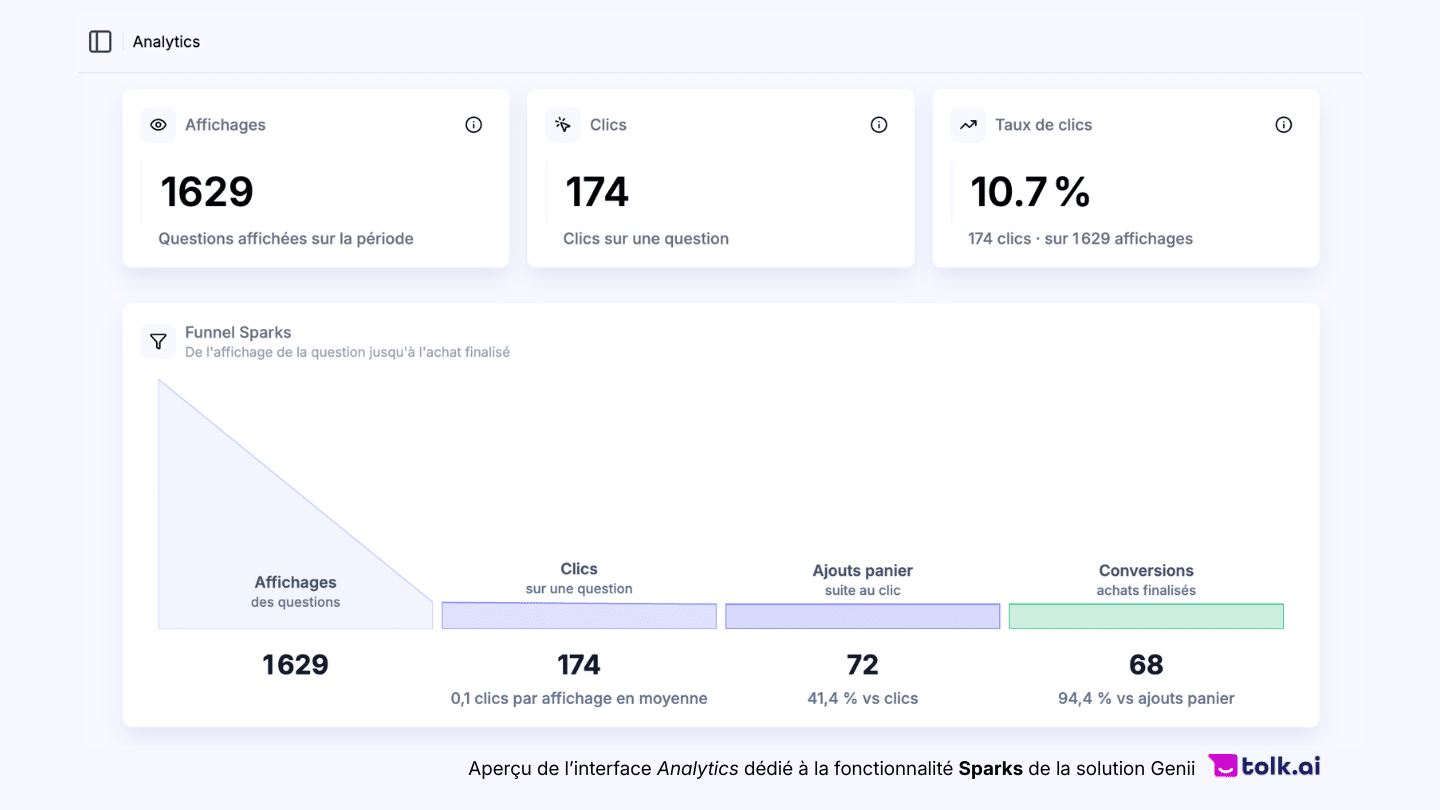
This feature turns silent hesitations into usable data for all teams, without any additional development, and without integration delay.
What Sparks changes for your e-commerce
Today, deploying a chat widget like Genii is essential. Designed to answer, it can nevertheless no longer be your only conversion tool.
Customer behavior is constantly evolving and new sources of friction appear: silent hesitation, a reduced attention window, and abandonment as the inevitable response. The cost of a visitor is rising, you no longer have the option to let them leave without having tried to convince them.
Sparks reverses this logic. It anticipates and resolves, before the customer even identifies a blocker. Sparks acts directly where the classic widget fails: conversion. Moreover, the results are concrete and measurable: less friction, fewer cart abandonments, more customers completing their purchase, and an unprecedented improvement in the analysis of purchase behavior.
Ultimately, for online retailers seeking to make customer experience a true lever of differentiation, Sparks represents a paradigm shift, not just another module with vague promises.
Sources: Baymard Institute (2024), Nielsen Norman Group (2023), tolk.ai internal data after 3 months of deployment.