Linguistic diversity has become a central component of customer relations. The multilingual customer experience can no longer be treated as a simple variation of existing support. It requires a structured approach capable of guaranteeing understanding, consistency, and continuity of service.
Faced with this complexity, multilingual AI agents are gradually establishing themselves as a structuring response. That said, understanding their limitations, their conditions for success, and their actual role in transforming customer service remains essential.
Table of Contents
The Multilingual Customer Experience: A Strategic Challenge in the Face of Linguistic Diversity
Understanding Linguistic Diversity Beyond Translation
Speaking multiple languages is not simply a matter of converting sentences from one idiom to another. Each language carries its own codes, conventions, and specific expectations. The same request can be formulated directly, implicitly, or with significant contextual nuance depending on the language used.
An effective multilingual customer experience therefore rests on the ability to understand intent, the level of urgency, and the expected register — not solely on the lexical accuracy of the response. Ultimately, without this nuanced understanding, perceived quality deteriorates quickly.
Operational Challenges of a Multilingual Customer Experience
Managing multiple languages at scale creates structural complexity: content multiplication, inconsistent responses, management difficulties, and rising costs. Human teams cannot always absorb this workload, particularly when volumes fluctuate significantly across periods or channels.
This is compounded by the risk of experience fragmentation.
Inconsistent responses from one language to another undermine trust and complicate the relationship between the organisation and its audiences.
Limitations of Traditional Multilingual Support Approaches
Traditional solutions typically rely on language-specific teams or translation tools. These approaches quickly reach their limits — particularly at larger scale or during peaks in activity, where they can struggle to keep up.
Furthermore, automated translation guarantees neither tonal accuracy nor contextual understanding for the customer. Multilingual human teams, for their part, are difficult to recruit and retain internally.
These limitations explain why many organisations are now seeking more sustainable approaches to improve their AI maturity and their ability to manage linguistic diversity within their customer relations.
AI Agents: A New Response to the Challenges of a Multilingual Customer Experience
Multilingual AI agents are built on models capable of understanding and generating language across multiple languages without systematically relying on a translation step. This approach enables a more fluid and natural interaction for the user.
Unlike traditional systems, an AI agent can incorporate business rules, shared knowledge bases, and behaviours tailored to each language. It thus becomes a single entry point for AI customer service, while respecting linguistic specificities.
This capability transforms the role of conversational AI: it is no longer limited to automating simple responses, but actively contributes to the overall quality of the multilingual customer experience.
How Does Genii, Our AI Agent, Concretely Improve the Multilingual Customer Experience?
Accessibility
First, Genii improves accessibility: users can interact in their preferred language, without constraint or redirection. This reduces friction from the very first contact.
Consistency
In addition, Genii ensures linguistic consistency and accuracy. Genii formulates its responses in line with the conventions of each language, uses appropriate terminology, and adapts its style to the cultural context and expected register. In short, this approach guarantees a reliable and comprehensible service for all customers, regardless of their nationality.
Availability
Finally, Genii extends service availability. It handles a large proportion of routine requests, independently of business hours and activity peaks. For complex situations, it redirects customers to the most qualified human agents, while maintaining a smooth and consistent experience.
Concrete Use Cases for Multilingual Conversational AI
In contexts with high linguistic diversity such as tourism, insurance, or e-commerce, conversational AI makes it possible to handle repetitive requests across multiple languages without degrading quality. It facilitates access to information, reduces response times, and standardises the perceived experience.
Companies also report improved allocation of human resources. Teams can focus on complex situations, while the AI agent manages standardised interactions.
These use cases illustrate the structuring role of multilingual AI agents in modernising multilingual customer support.
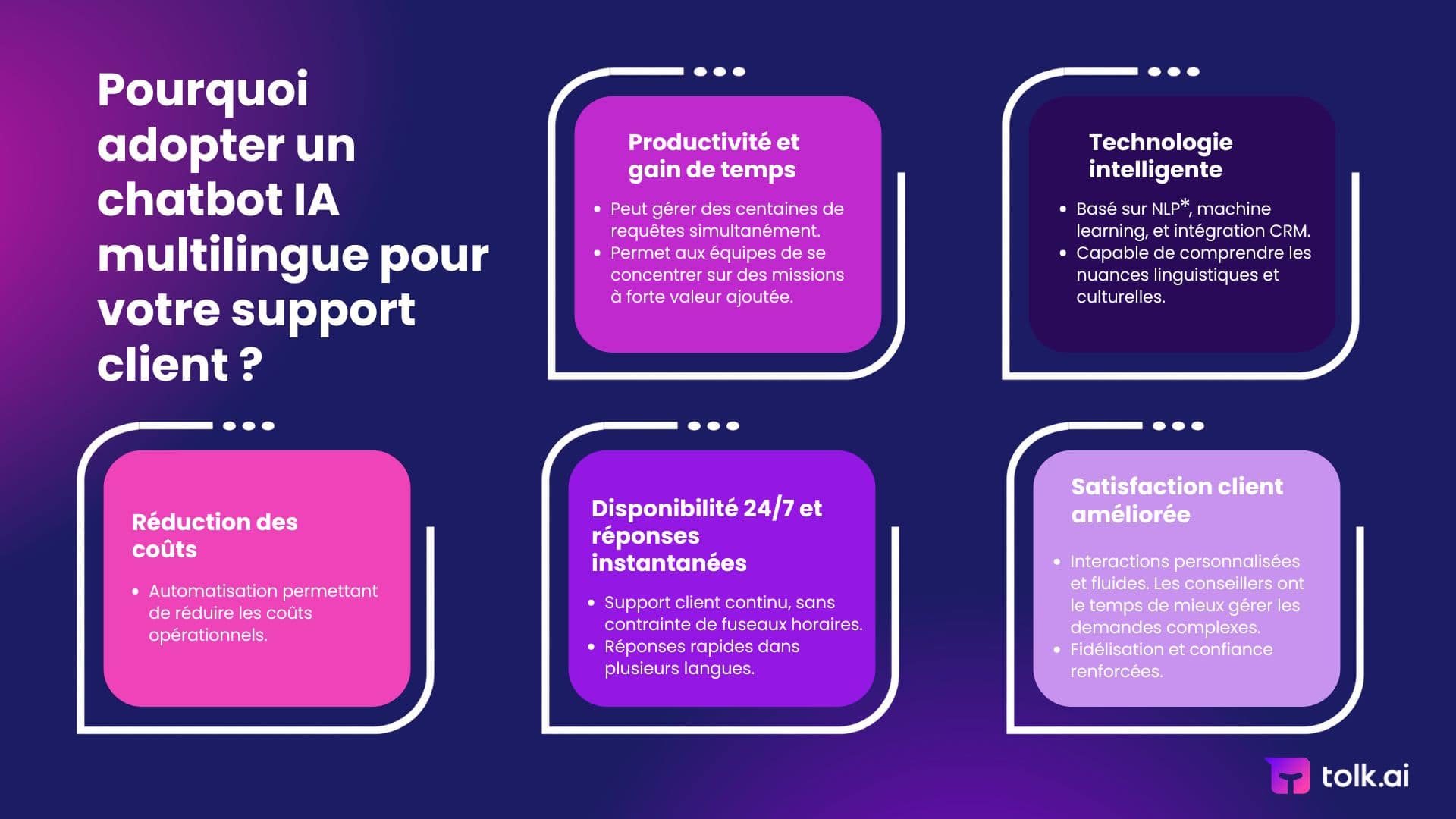
*NLP (Natural Language Processing): a branch of artificial intelligence that enables machines to understand, analyse, and produce human language.
Towards a Borderless Customer Experience: New Perspectives
Truly Understanding Consumer Needs
As models continue to advance, AI agents handle longer, more nuanced, and more contextual conversations. The result: the customer experience becomes more fluid, even in environments where language, accents, or phrasing vary significantly.
This is what is referred to as agentic AI: the agent no longer simply responds, it chains multiple steps and acts on behalf of the colleague. For example, by searching for information, opening a ticket, updating a CRM, or triggering an escalation to a human for requests it could not resolve — all with the goal of saving support teams precious time.
The Result: A High-Quality Customer Experience
In this context, multilingual capability is no longer simply about “speaking multiple languages”. It becomes an operational capability: the agent must understand the request in the user’s language, but also interact with tools and knowledge bases that may be in a different language, while ensuring a consistent and reliable response. Thanks to native multilingual support, continuity is guaranteed end-to-end, regardless of the entry point (chat, email, form, telephone).
The AI agent thus becomes a cornerstone of the customer experience strategy: it streamlines customer journeys, standardises service quality internationally, and frees human teams to focus on higher-value tasks.
Conclusion
The multilingual customer experience is now a lasting strategic priority. Multilingual AI agents offer a credible response to this complexity, provided they are deployed with method and rigour.
By investing today in multilingual AI chatbot solutions, companies position themselves to meet the expectations of tomorrow’s customers, strengthen their competitive advantage, and build lasting relationships with their international customers.