In our previous article, we explored why general-purpose large language models (LLMs) such as GPT or Gemini represent a legal risk for insurance companies, for lack of being anchored on your contractual data.
Today, we go further: how can automated document analysis not only answer your policyholders, but also automatically process the documents that structure their relationship with you?
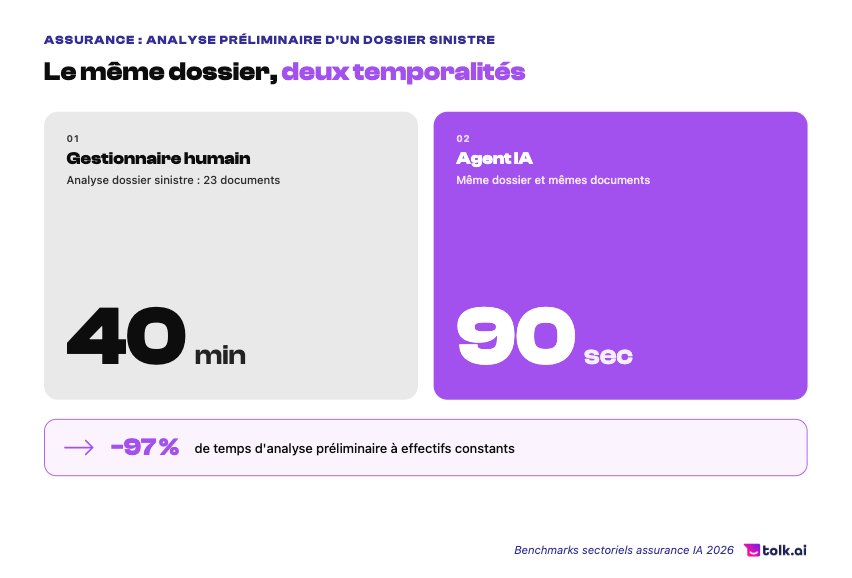
A claim file contains on average 23 documents. An experienced handler takes 40 minutes to analyze them. An artificial intelligence (AI) agent anchored on your reference data does the same work in 90 seconds. This is not science fiction, it is what your most advanced competitors are deploying right now.
The loss of precious time for your teams
Ask a claims handler to describe their morning. They will tell you about attachments to open one by one, dates to cross-check, certificates to verify, clauses to locate in 80-page general terms and conditions, ceilings to calculate before being able to process the slightest file.
These operations are all necessary, certainly, but they are also all deeply repetitive. Indeed, they take up the attention of your best profiles on tasks where their human expertise makes no difference compared to a properly configured tool.
Concretely, in a company handling 50,000 claims per year, this workload represents between 33,000 and 40,000 hours per year devoted exclusively to document verification (estimate from the Accenture Insurance benchmarks, 2024).
So this is not a problem of work volume. It is above all a problem of allocating human skills where they would have the most value.
Why optical character recognition (OCR) is not enough?
Most attempts at document automation in insurance fail for the same fundamental reason: they rely on optical character recognition (OCR) tools that extract raw text without understanding its meaning or the context of the document. These tools can read words, but they cannot interpret what those words mean in your business environment.
An AI agent trained on your internal reference data does something entirely different. It does not merely read what is written in the document: it understands what that document means in the precise context of your coverage grid, your underwriting rules and the contractual history of the customer concerned. It is this layer of contextual interpretation that changes everything!
Thus, the agent can answer in a few seconds questions that your current systems do not process automatically: is the date of the incident earlier than the effective date of the contract? Does the declared amount exceed the coverage ceiling of this plan? Is a mandatory document missing according to your internal admissibility rules? These are all checks that your handlers carry out manually today, and that can be delegated to AI as soon as the data is available.
Automated document analysis: 3 examples where the gain is immediate
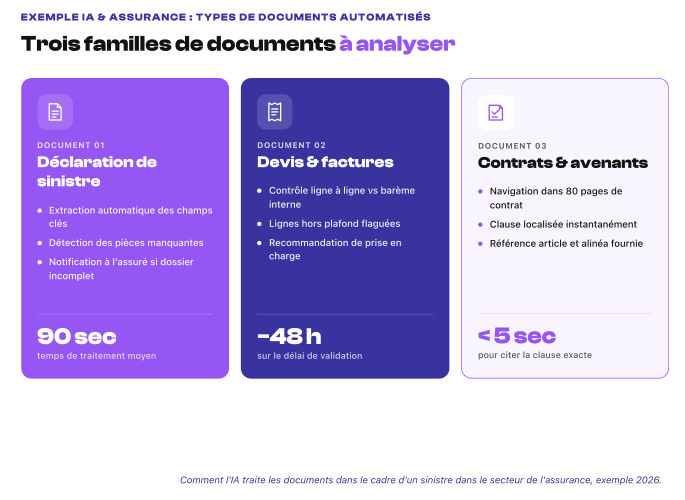
1. Claim declarations
When a claim declaration is received, the AI agent automatically extracts the key information, checks the consistency of the data with the terms of the contract in force, detects missing documents according to your internal rules and pre-qualifies the complexity level of the file. This preliminary work, which previously took a handler 20 minutes of careful reading, is now done in 90 seconds. The handler receives a structured summary and can immediately focus on the business analysis.
2. Repair quotes and invoices
For each quote or invoice received from a provider, the AI automatically checks the amounts against internal scales, detects the lines that exceed the coverage ceilings and compares the amounts with the history of similar claims processed previously. Rather than receiving a raw document to decipher, the handler obtains a pre-analyzed report that they only have to validate or adjust according to their professional judgment.
3. Contracts and amendments
Moreover, the AI agent can navigate instantly through dense documents. It locates a specific clause in a few moments, checks an effective date or confirms whether a particular exclusion applies or not to the declared situation.
Finally, what previously required a tedious manual search is now done without delay, which considerably frees up the teams’ time for the most complex cases.
Automation and impact on processing times
Consequently, the deployments of AI-powered document analysis in insurance converge toward three measurable results that are consistent from one player to another.
First, the average processing times for simple claims drop by 50%, the preliminary analysis phase being entirely automated and the handler intervening only on the cases requiring human judgment.
Second, the volume of incomplete files submitted to the processing queue decreases by 35%, the AI agent detecting the missing documents upon receipt and immediately notifying the policyholder.
Lastly, the productivity of handlers on complex files increases by 40%, the latter being finally freed from the repetitive level 1 document workload.
Summary
Document automation is not an 18-month systemic transformation project. On targeted and well-defined use cases, the first gains are visible in just a few weeks, without requiring the slightest overhaul of your existing information systems.
In conclusion, the operational productivity of your teams freed up by AI is not an unattainable goal. This analysis took the example of the workload that document processing represents for insurance handlers, but the capabilities of AI are varied.
In our next article, we will show you concretely how these results were achieved at an insurance player, with the precise figures of the deployment and the method used step by step.
Sources
- Celent. (2025). The acceleration of Gen AI adoption. https://www.celent.com/en/insights/the-acceleration-of-gen-ai-adoption
In the previous article, we highlighted the fact that the quality of the customer relationship in insurance no longer depended at all on the support service in 2026.