In our previous article, we showed how an artificial intelligence (AI) agent anchored on your business reference systems can read, interpret and pre-analyze your claims documents where classic OCR* merely extracts text.
The analysis below addresses AI use cases in insurance that work and the results associated with the deployments of our solution Genii.
*The acronym for Optical Character Recognition, in French reconnaissance optique de caractères, is a technology that enables the recognition of textual content.
The dead time that no one measures
For most of the insurers we support, the first observation is identical. The teams have already optimized their human processes. The case handlers are trained, the procedures are documented and the indicators are improving, but slowly, because the “easy” gains have already been captured.
Furthermore, what has not yet been addressed in the majority of organizations is the dead time between steps. For example:
- the incomplete file waiting for a document,
- the quote waiting to be checked,
- the incoming “where is my file?” call that ties up an advisor for 7 minutes for information available in the system.
For the companies we support, this dead time represents on average 55 to 60% of the total processing time of a claim. Note that it is not caused by human inefficiency. It is simply caused by steps that have not yet been automated.
The three high-ROI AI use cases in insurance
Our Genii deployments systematically begin with use cases for which the necessary data is already available and structured.
This approach makes it possible to obtain measurable results within a few weeks. Here are 3 concrete use case examples.
1. Assistance for policyholders and help with procedures
First, Genii is fast in its analysis. It knows the procedure to follow and can identify the supporting documents according to internal eligibility rules. When a customer reaches out, it is also able to guide the policyholder based on their personal situation and support them through their procedure. As a result, the policyholder gets all the information in real time. They therefore submit a complete file and its processing time is significantly reduced.
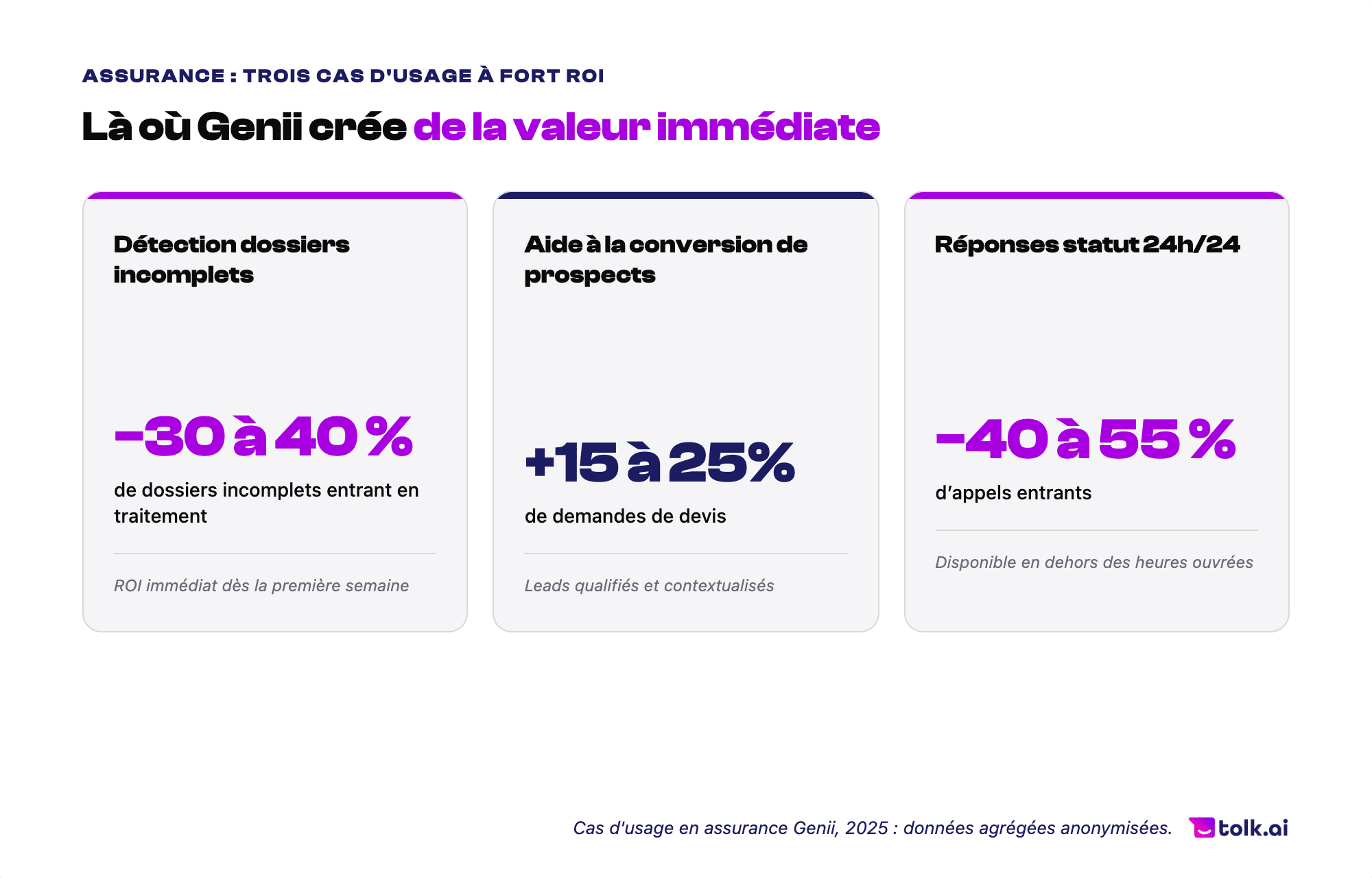
The observed benefit is direct. The volume of incomplete files entering processing is reduced by 30 to 40%, which mechanically removes a major source of delay and administrative follow-up.
2. Help with prospect conversion
Moreover, Genii is a virtual seller able to remove prospect friction from the moment they enter the acquisition funnel. Trained on the insurer’s knowledge base, it knows the commercial discourse to adopt. It is also connected to the CRM and masters the commercial offers. Finally, it is able to detect hesitations or complex situations and redirect to a case handler. This use case creates 15 to 20% additional quote requests.
3. Autonomous answers and resolution
Finally, one of the important use cases in insurance rests on autonomous resolution.
Genii answers status requests from policyholders 24/7, with day-level accuracy on progress and next steps. On the deployments observed, incoming calls on the tracking topic drop by 40 to 55% within the first weeks. This availability also reduces the Monday-morning call peak generated by the questions accumulated over the weekend.
Consequently, the support teams are relieved of this workload. Also, policyholders benefit from better handling thanks to immediate answers even outside business hours.
The results observed on AI deployments
On the deployments observed, the indicators converge toward the following ranges.
The average processing time for routine claims drops by 45 to 55% when the three use cases above are deployed. The reduction varies according to the starting point: organizations with an initial timeframe greater than 15 days record the largest gains in absolute value.
Furthermore, the volume of incoming calls on the “file status” and “missing document” topics drops by 40 to 50%. These two topics generally represent the leading causes of incoming contact in a policyholder relations center, which makes this gain an immediately visible impact on the teams’ workload.
In addition, the Net Promoter Score (NPS) for policyholders who have experienced a claim improves by 12 to 20 points on average. This score is mainly attributed to the responsiveness of the incomplete-file notification and to the transparency about progress.
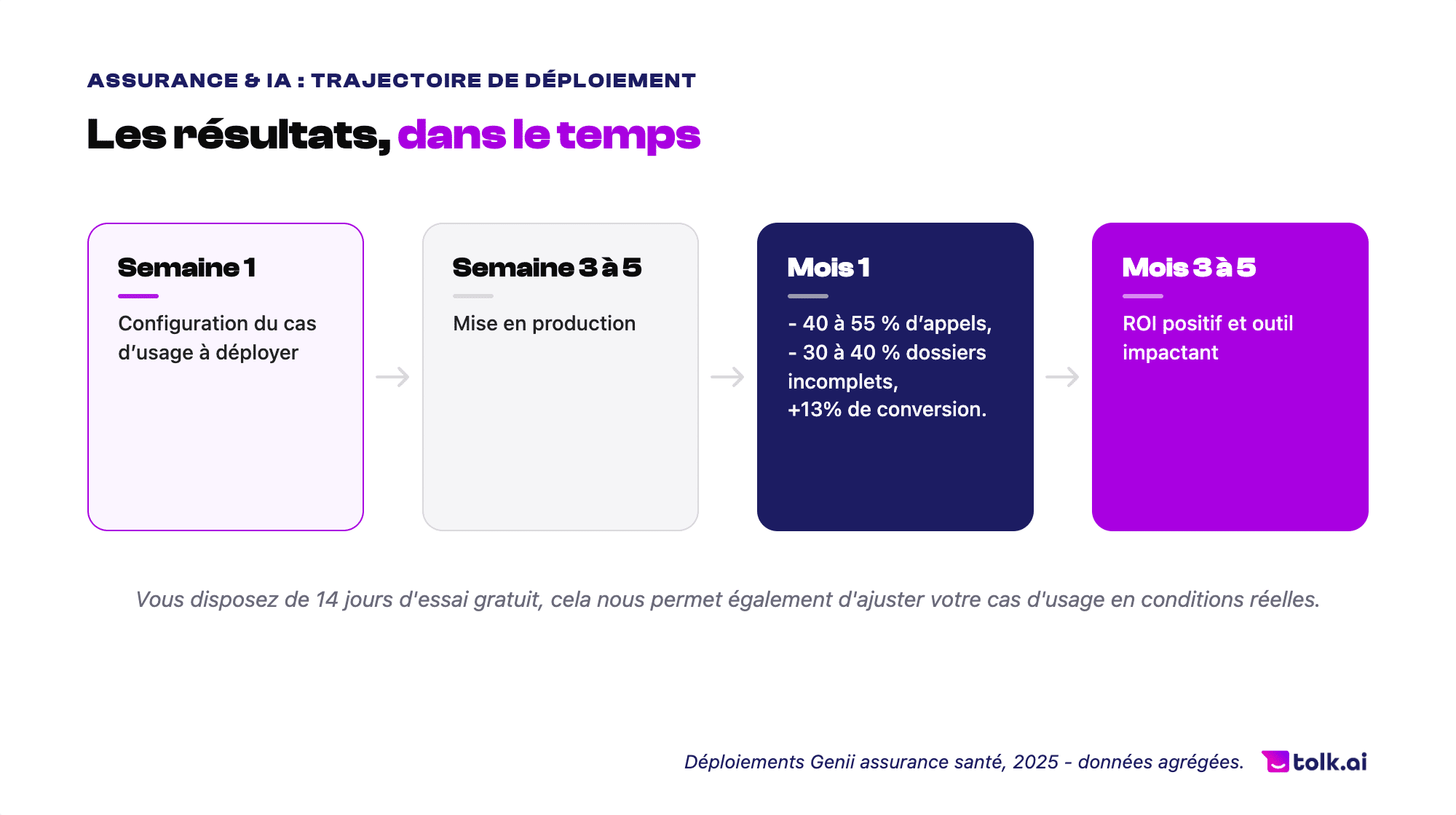
The return on investment becomes positive from the 3rd month of deployment, on the basis of savings on processing costs and avoided incoming calls alone.
A timing that can transform the decision
Indeed, automation projects in insurance have often been postponed for the same reason: the time to production. It is often incompatible with the teams’ schedule. A 12-to-18-month project systematically gets blocked by other priorities.
Genii deployments on the three use cases described above are operational in 3 to 5 weeks on average. This is from scoping through to going into production (test phases included). This velocity fundamentally changes the equation. It becomes possible to prove a measurable impact before the end of the quarter, without technical skills or the recruitment of specialized profiles.
Conclusion
Finally, claims teams are not slow or inefficient. They spend time on tasks that do not require their expertise. Automating these steps does not reduce headcount: it gives them back time on complex files, those where their judgment really makes the difference.
Our experts offer you a free diagnostic to identify the use cases to deploy first in your organization.
Sources
To conclude, the figures presented here come from the Genii deployments observed in 2025. The scopes concerned are those of health insurance, personal protection, home insurance and property and casualty insurance. They are presented as observed ranges, without attribution to a specific player.