In our previous article, we showed why online information is not enough for the most vulnerable audiences and how level 1 artificial intelligence (AI) makes it possible to refocus agents on complex situations. The Prefecture of the Brittany region has just demonstrated, through a pilot, that this change is not only possible but measurable.
In March 2026, Thomas Sabatier, CEO of tolk.ai, and Julien Kounowski, director of the regional digital innovation platform of the SGAR Brittany, presented the results of the pilot carried out in Ille-et-Vilaine with the support of the Ti-Lab. This feedback was presented during a webinar bringing together more than forty participants from the public sphere. The figures presented here come from this session.
A problem common to the entire public sector
First, the situation is not specific to Ille-et-Vilaine. In 2025, the public finance department alone received 11 million calls, more than one million more than the previous year. The answer rate in public service call centers does not exceed 40%, whereas the target set by the State is 85%. Furthermore, 11 million French people suffer from digital illiteracy and 46% experience difficulties with digital tools, which makes the mere digitalization of services insufficient to ease the pressure on counters.
Administrative complexity represents an estimated cost of 100 billion euros per year (Webinar tolk.ai x Prefecture of Brittany, 19 March 2026), that is 3.5 to 4% of gross domestic product (GDP). Agents are under pressure, users are frustrated, and the traditional information channels, static FAQs first and foremost, are largely neglected.
It is in this context that the Prefecture of Ille-et-Vilaine, supported by the SGAR Brittany, launched a pilot with a conversational artificial intelligence agent.
A pilot carried out on immigration law
First, the choice of scope is not insignificant. The procedures related to residence permits concentrate a significant share of incoming requests, in several languages, with procedures that change frequently. This is precisely where the pressure on agents is greatest and where information is hardest to standardize.
The project team was made up of around five people. In three weeks of configuration, it built a knowledge base of 185 resources: legal texts, user notices, PDF documents, internet links to the official prefecture sites, bilateral agreements between France and various countries, and even the Code on the Entry and Residence of Foreigners (CESEDA) in its entirety. This base was made available to Genii, the agentic artificial intelligence engine of tolk.ai, whose answers are anchored exclusively on these verified sources.
In addition, Julien Kounowski stressed one point during the webinar: the value of the pilot does not lie solely in the results. It also lies in what it revealed about the quality of the information available internally. The AI agent acted as a mirror, pointing out outdated or contradictory data on the prefecture website. This is a valuable side effect that no one had anticipated.
AI and the public sector: results and measured data
Quality of answers and reliability of the AI agent
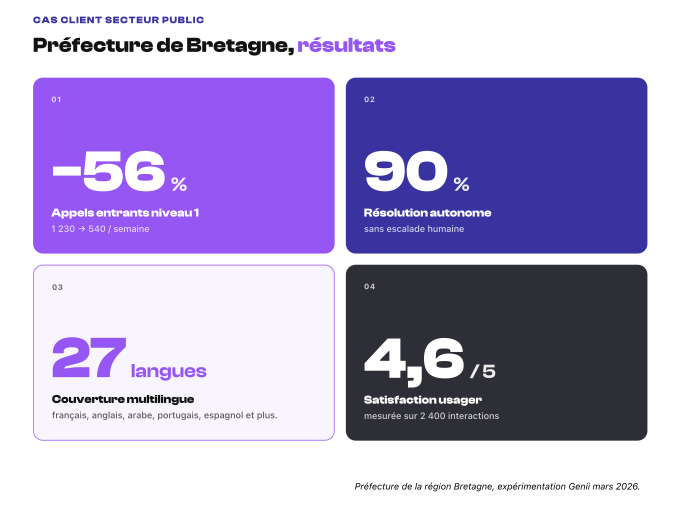
Furthermore, the pilot was conducted with the general public, with the agent deployed directly on strategic pages of the Ille-et-Vilaine prefecture website. In one month of use, the agent generated more than 2,500 conversations, a volume higher than all the other contact channels of the prefecture combined over the same period (in-person appointments, phone calls, online forms). This figure alone shows that the pilot reached an audience that was not finding answers through the existing channels.
Regarding the quality of the answers, the technical assessment conducted by the SGAR teams established a rate of 92% reliable and satisfactory answers. This figure must be put into perspective: during the internal tests carried out with prefecture agents ahead of the public launch, the rate was 70%. The progress is explained by the successive iterations on the knowledge base and the behavioral framing of the agent through the prompt.
User feedback and satisfaction
Next, users for their part expressed a positive sentiment rate of 98%, measured across all the conversations analyzed. More than 40% of the exchanges took place outside the prefecture opening hours, which confirms that the pilot did broaden the service offering rather than simply replace part of it.
In addition, on the multilingual dimension, more than 20% of the conversations involved a foreign language. The agent supports 27 languages natively, which allowed non-French-speaking users to phrase their questions in their mother tongue while receiving, according to their preference, answers in French or in the chosen language.
Finally, the pilot caused no service disruption and no institutional alert. No association and no external party challenged the system.
AI and the public sector: for the benefit of agents and users
In conclusion, the main barrier to adopting conversational AI in the public sector is neither budgetary nor technological. It is the fear of an incorrect answer that engages the responsibility of the institution.
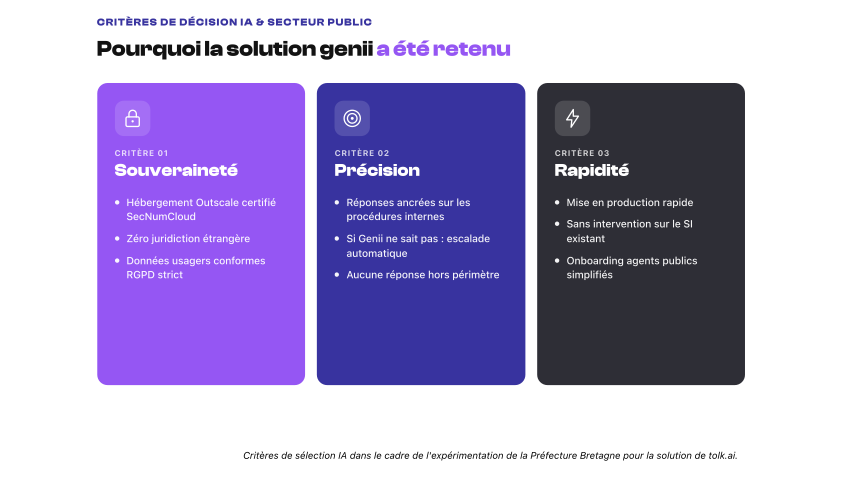
The Brittany pilot provides a concrete answer to this objection. The tolk.ai solution produces only answers anchored on the sources you have provided. When it does not have the information, the AI agent says so explicitly and directs the user to a human agent. Every interaction is logged and auditable.
Furthermore, compliance with the RGAA (French accessibility standard) reaches 97%. Hosting on the SecNumCloud-certified Outscale France infrastructure guarantees, for its part, the sovereignty of user data.
Finally, the next step for the Prefecture of Brittany is to consider a regional or even national pooling of the model. The ambition is to make the system accessible locally while taking into account the specific features of each territory.
Sources
Sabatier, T. & Kounowski, J. (2026, 19 March). Comment l’IA rend le service public accessible à tous, tout le temps ? Link to the webinar replay
Préfecture de région Bretagne & tolk.ai (2026). Synthèse des échanges : Webinaire du 19 mars 2026. Restricted distribution, available on request.
Préfecture d’Ille-et-Vilaine. (2026, March). Bilan après expérimentation d’un agent conversationnel IA. Internal document, SGAR Bretagne.
Défenseur des Droits. (2025, October). Relations des usagers avec les services publics. https://www.defenseurdesdroits.fr
Direction interministérielle du numérique (DINUM) & Programme Services Publics. (2025). Synthèse des rapports 2024-2025.
Agence nationale de la sécurité des systèmes d’information (ANSSI). (2024). SecNumCloud : référentiel de qualification. https://www.ssi.gouv.fr/
If your administration wishes to embark on this approach, tolk.ai offers a diagnostic of your reception flows and a workshop to map your priority use cases, with no commitment.