An employee at a prefecture receives 47 calls a day on average. 31 of them are about information available online. This is not a communication problem. It is a problem of real accessibility: the information exists, but the user cannot access it on their own.
How can you balance workload and service quality while using AI to automate certain tasks? This article explains how AI solves some of the challenges of public service.
AI & public service: an accessibility challenge
Understanding the context behind this accessibility challenge
Behind these informational calls, there are no lazy users who simply did not search.
Most of the profiles that need dedicated support are generally less inclined to use technology. Among them are elderly people without internet access, non-French speakers facing an entirely French-language website, and people with disabilities blocked by an inaccessible PDF form. There are also users who searched, did not find anything, and eventually picked up the phone.
Each call of this kind costs between 4 and 8 minutes of an employee’s time. Moreover, it creates a sense of burden for the public worker, and often frustration for the user who had been waiting in the queue for 10 minutes.
Furthermore, the cycle repeats the next day, with another user, for the same question, and so on.
This cycle is not inevitable. It is the product of an information architecture that was not designed to meet the real needs of the most vulnerable users.
Why is putting information online no longer enough?
First, the implicit assumption behind the digitalization of public services is that the user is able to find the information they need on their own if it is available on a website. This assumption is false for a significant portion of the population.
- 12.4 million French people with disabilities often face insurmountable technical obstacles on sites that do not comply with the RGAA (French accessibility standard).
- 38% of people over 75 do not use the internet.
- 4 million non-French-speaking residents face sites available only in French.
These groups are not on the margins. They represent a structural share of your reception flow.
Second, putting information online does not necessarily solve this problem. Indeed, the vast majority of those who call have already tried to find the answer on their own. By definition, they are therefore capable of obtaining it, but the complexity of the administration is sometimes a barrier. As a result, they take up public workers’ time at the expense of people who genuinely need dedicated support.
What an AI agent actually does at first contact
To solve this accessibility problem by offering the right service to the right user profile, some administrations turn to artificial intelligence.
An important clarification: an AI agent properly deployed within an administration does not replace the public worker. It absorbs the requests for which human added value is nil. For example, it answers questions about opening hours, the documents required for a file, the status of an ongoing request, processing times, or the translation of a procedure.
Moreover, it does so continuously, with no waiting time, in the user’s language, and with the level of precision of an employee trained on your internal procedures. Safely, it automatically escalates to a human as soon as the situation goes beyond its scope of competence.
Three concrete effects are systematically observed in administrative deployments:
- -40 to -60% incoming phone calls on front-desk questions, from the very first weeks of deployment.
- Availability 24/7 for informational requests, which reduces the Monday-morning call peak generated by unresolved weekend questions.
- Improvement in the quality of service as perceived by employees: freed from repetitive questions, they refocus on the complex situations that require their expertise and skills.
AI in the public sector: the question every administration should ask
How many of your users abandon their procedure each week, not because the procedure is too complex, but because they could not get the answer to a simple preliminary question?
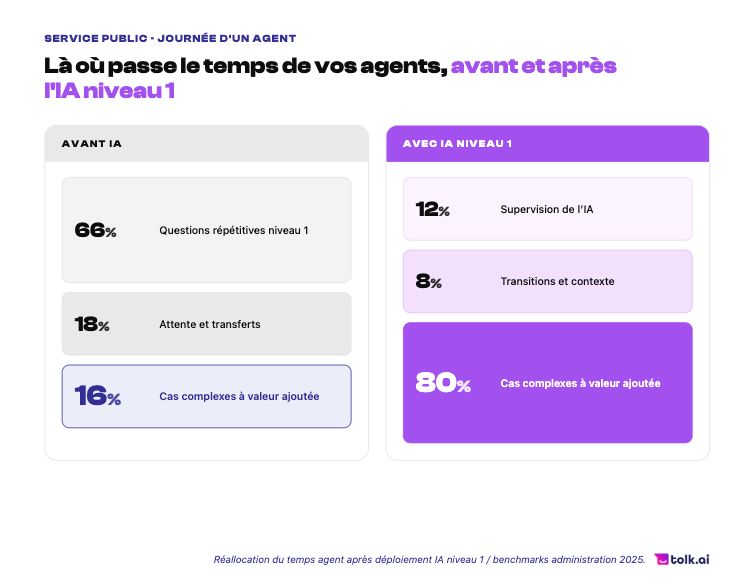
This silent abandonment rate appears in none of your reports. Yet it can be measured in the number of users who give up a right, in the reception tensions that could have been avoided, and in the number of employees overloaded by a volume that should not reach them. So-called level 1 AI is not a headcount-reduction tool. It is a tool for reallocating value: putting human expertise back where it makes a difference, and letting automation handle what does not require judgment.
In our next article, we explain how the Prefecture of the Brittany region reduced its incoming calls by 56% and reached 90% autonomous resolution with Genii, the agentic AI solution from tolk.ai.
Useful resources
- DINUM, Digital accessibility review of State services 2024
- Defender of Rights, Digitalization and inequalities of access, 2022
- Digital barometer, CREDOC/ANCT, 2025
- INSEE
In the previous article, we discussed sovereignty and the challenge of the Cloud Act for the public sector.