Cart abandonment is frequently attributed to pricing considerations. In reality, it most often results from an unresolved question during the purchasing process. This cognitive friction, however minor, proves decisive in the final decision.
To remove these blocking points, more than 130 companies have already adopted the Genii solution. Historically, online assistance relied on the traditional conversational widget. Although omnipresent, this format remains passive: it requires a voluntary step from the user to start the interaction.
Yet a visitor in the midst of doubt does not necessarily go across the page to open a chat, type out a request, and wait.
The real challenge does not lie in adding yet another support channel. It lies in the ability to deliver the exact answer right where hesitation arises. The goal? Securing the conversion before the user leaves the sales journey.
The Sparks, Finder and Ask AI features reverse this logic. Instead of directing the visitor toward the AI, we integrate the AI directly into their browsing flow, at the precise moment their need emerges.
User behavior has changed
Beyond the interface, it is our consumption habits that have evolved. Google has just progressively rolled out AI Overviews and AI Mode in France. This is proof of the growing expectation for instant and contextualized answers.
A user accustomed to instantaneity now perceives any intermediate step (sorting through results, filling out a form, or feeding a chat) as unnecessary slowness. This perception has a direct impact: it inevitably translates into a lower conversion rate in the e-commerce sector.
Our three solutions, Sparks, Finder and Ask AI, each step in at a strategic moment of the customer journey. They are also natively integrated into the Genii ecosystem to make every interaction smoother.
Key features that answer this new journey
Search: Finder
First, the search bar is the direct expression of purchase intent. Yet it often leads to disappointment when the user is faced with an exhaustive list of products to compare manually. The modern buyer no longer wants to sort through options; they want a qualified recommendation.
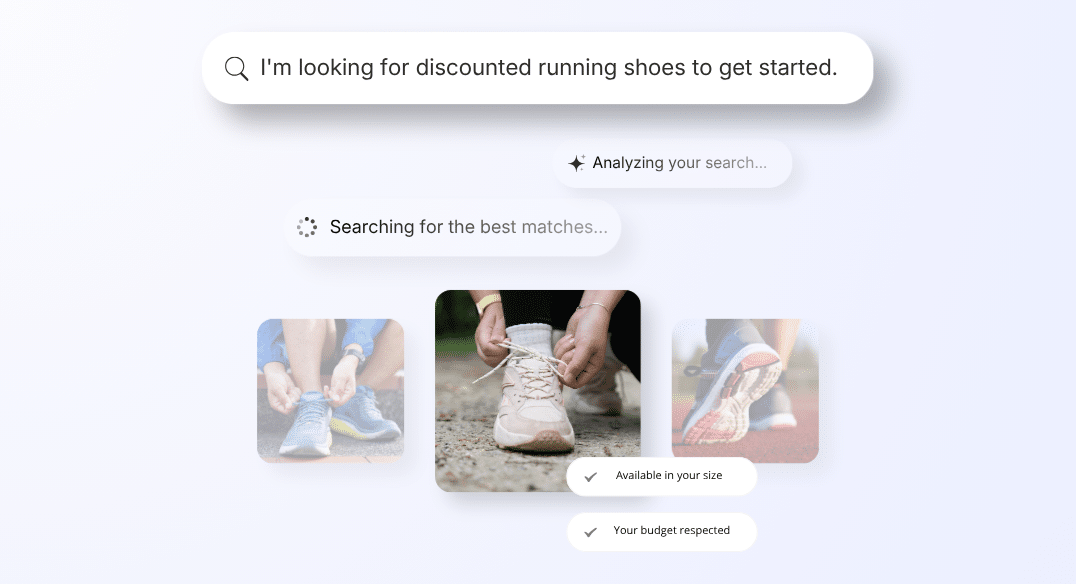
Finder transforms this experience. By replacing generic lists with a targeted selection of products paired with personalized reasoning, the feature plays the role of an expert assistant. As a result, this first point of contact becomes a major lever for retention.
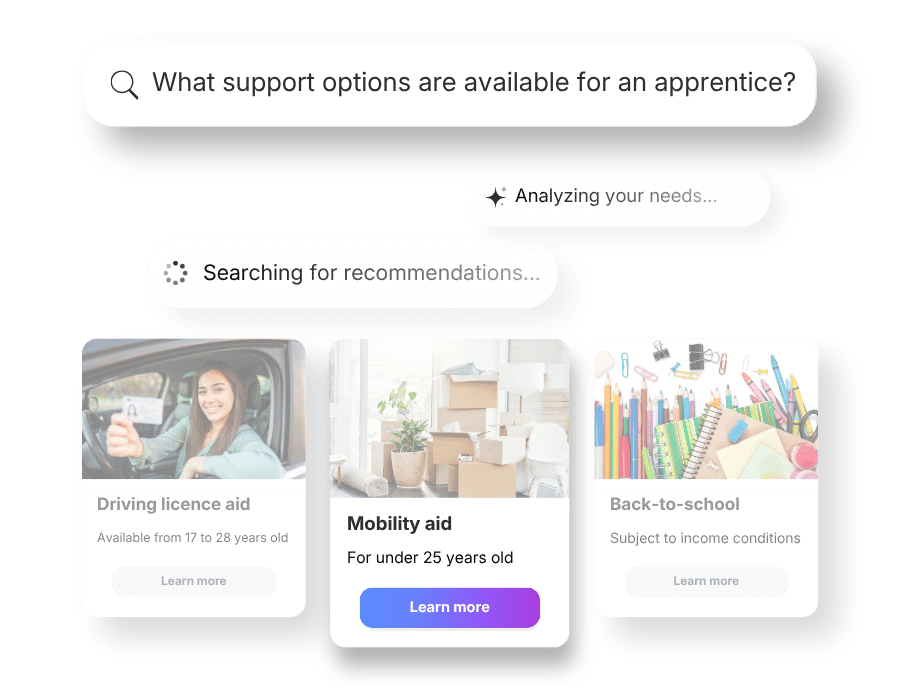
Finder optimizes the search phase through advice delivered directly within the conversation.
Hesitation: Sparks
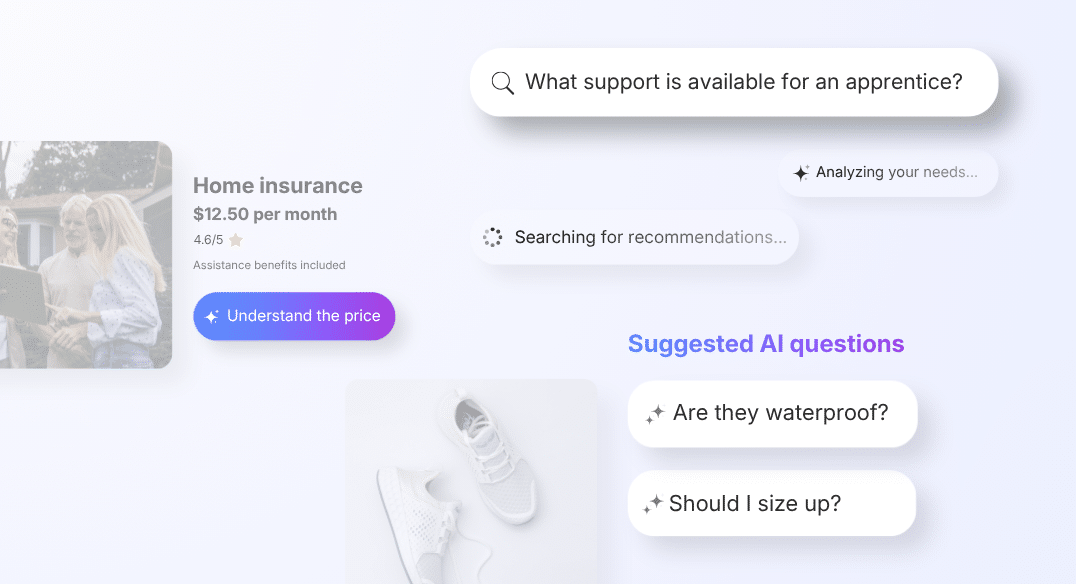
What’s more, on a product page, attention span is extremely limited. During this critical window, questions about size, compatibility, or return conditions can arise. If these doubts are not addressed immediately, the user will tend to abandon the purchase.
Sparks anticipates these questions. Directly on the product page, wherever you choose to place it, the AI surfaces likely objections and answers them in one click. You resolve the doubt before it blocks the sale.
Even better, the answer is not necessarily in text format. Genii can display a carousel of recommendations (photos, price, description, add-to-cart call to action). The visitor clicks on a personalized suggestion and sees two or three jackets appear that match their expectations. In the end, conversion is simplified.
By displaying answers to likely objections directly under the product, the AI neutralizes the barrier to purchase before it crystallizes. The interaction is immediate and non-intrusive.
Engagement: Ask AI
Furthermore, when browsing complex content (comparisons, pricing grids, or simulators), the user’s attention is often focused at the center of the screen. In this context, an off-to-the-side widget loses effectiveness because it requires extra cognitive effort to be used.
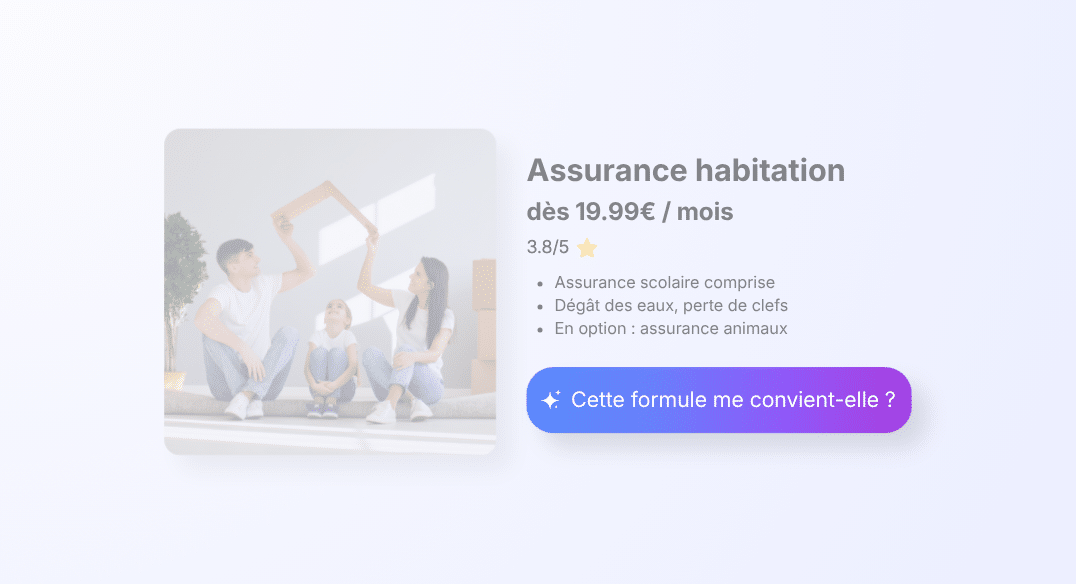
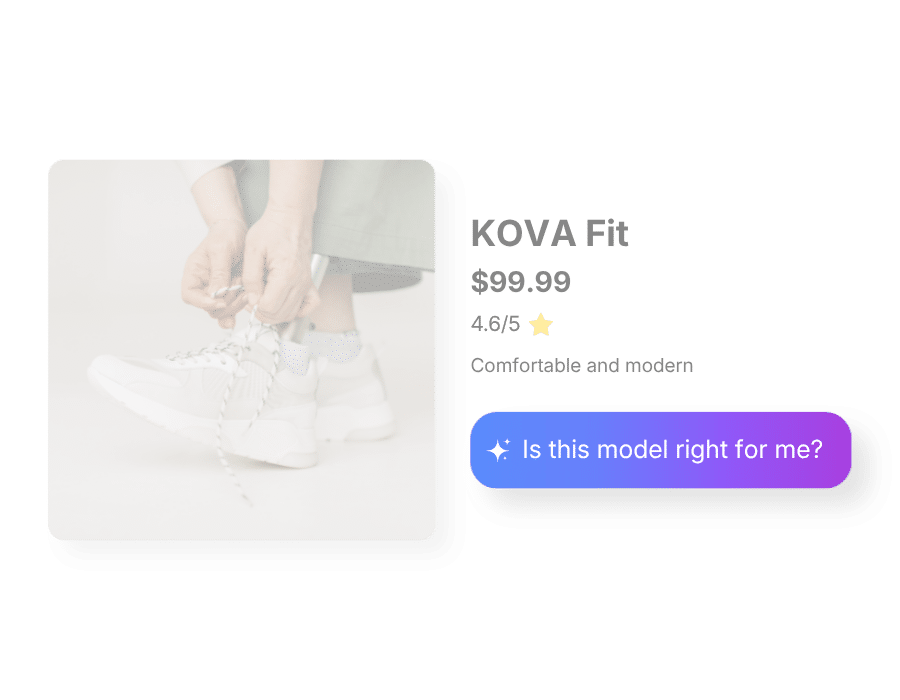
Ask AI makes it possible to integrate a conversational entry point exactly where the decision takes shape. Thanks to personalized and contextualized calls to action (CTAs), you start a proactive and high-quality dialogue, perfectly aligned with the intent of the page.

You write the label yourself: it's a CTA calibrated to the page's intent, opening the conversation directly.
Advanced analytics for performance-driven management
Furthermore, these tools work in synergy. They hand off to each other seamlessly throughout the journey to maximize the value of every visit.
Beyond improving the user experience, each solution provides precise performance indicators. In fact, the ROI Tracker feature makes it possible to correlate interactions (clicks, cart additions) with tangible revenue, offering rigorous analytical visibility.
This data-driven approach makes it possible to identify the best-performing levers by page and by language. Insights from Finder reveal your audience’s real concerns, while Sparks and Ask AI allow you to continuously optimize conversion journeys. Ultimately, these hesitation signals, once silent, are now turned into actionable data to steer your e-commerce strategy.
You therefore know precisely which tool, on which page, and in which language, tipped a visitor toward a purchase.
In summary: a simplified journey
In conclusion, optimizing the customer journey does not require multiplying tools, but bringing intelligence right where value is created: at the very heart of the user experience.
Sparks anticipates the question, Finder answers instantly, and Ask AI diversifies contact opportunities. Three different triggers for one shared conviction: AI no longer waits to be called upon, it is proactive with your visitors.
Lastly, our three solutions, Sparks, Finder and Ask AI, each step in at a strategic moment, natively integrated into your Genii ecosystem to make every exchange smoother.