A chatbot, in the broad sense of the term, is a virtual assistant deployed on a website or a messaging application (Messenger, WhatsApp, …), capable of handling a conversation in natural language or at minimum a guided decision tree.
There are two families of chatbots: linear bots (“dumb bots”) and “intelligent” bots (NLP chatbots).
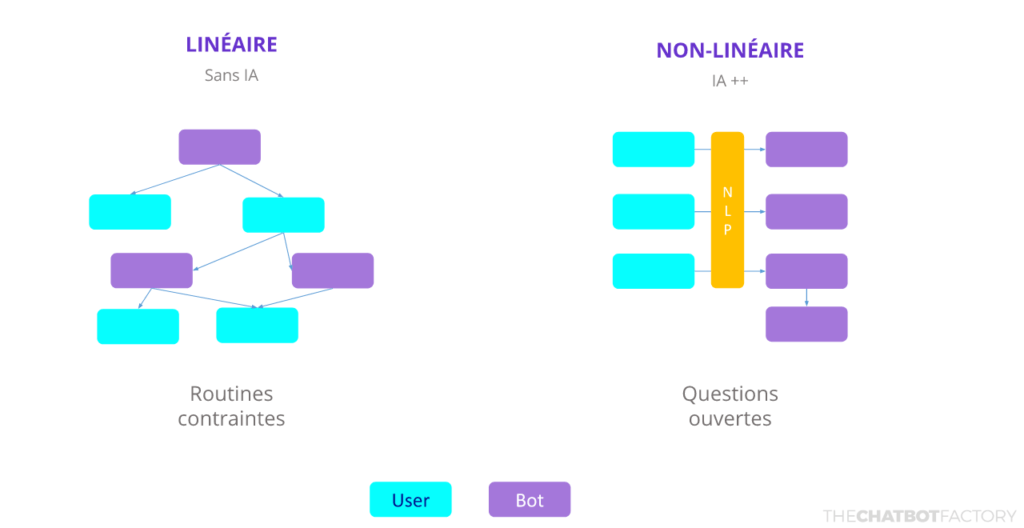
Dumb bots: linear chatbots
First, linear chatbots rely on predefined decision trees. The user experience is sequenced step by step, chaining mechanically and enabling navigation through a more or less complex tree structure. No intelligence is involved; the user experience is similar to navigating a graphical interface.
Advantages:
- closed paths, few possible errors,
- simple to build in POC format
Disadvantages:
- difficult to scale,
- poorly suited to “customer service” use cases as they struggle to manage rich knowledge bases,
- the entire journey must be rethought whenever any part of the scope changes,
- no listening to customer requests or collection of customer verbatim.
NLP Chatbots or Virtual Assistants
Conversely, an NLP chatbot understands user intent and adapts its response in real time.
Still not widespread, they suffer from an image tarnished by implementation difficulties and often underwhelming performance.
Since 2016, the emergence date of automated natural language processing technologies, the performance and reliability of these technologies have continued to improve. At The Chatbot Factory, we have undertaken the development of our own NLP technologies with the ambition of simplifying their deployment by non-technical users and improving their ROI.
NLP chatbots are the highest-performing virtual agents on the market! Fluid, free, and “intelligent”, AI-powered conversational agents are the most human-like.
Nevertheless, they can prove complex to implement. They rely on machine learning technologies that require a significant amount of available and structured data.
In this domain, the tolk.ai platform (developed by The Chatbot Factory teams) innovates by combining two approaches to automated natural language processing: the semantic approach and the machine learning approach. They complement each other perfectly with the goal of delivering performance from the very first days of chatbot operation, while ensuring continuous improvement as the chatbot learns from the conversation data generated.
Advantages:
- no decision trees constraining the experience,
- fast resolution of the request,
- ability to pivot toward other topics or related content,
- user experience close to a “human” conversation,
- flexibility in evolving journeys and knowledge bases,
- customer listening based on questions asked,
- intelligent and dynamic escalation to a human agent,
- ability to respond in a personalized way,
- higher user satisfaction level.
Disadvantages:
- more frequent out-of-scope situations,
- choice of technology (prefer hybrid models),
- more demanding in terms of performance monitoring.
Tolk advantages:
- Hybrid NLP Technologies,
- Setup in 1 to 2 hours from a FAQ,
- Native and automatic disambiguation,
- Automatic and dynamic generation of training data sets,
- Auto-evaluation of model performance for continuous optimization.
Why Launch Your Chatbot?
NLP chatbots are thus establishing themselves as a strategic solution for automating complex requests. Today, consumer expectations and behaviors have evolved significantly toward digital environments. Messaging, chat, and other instant messaging platforms have colonized our daily lives. Whether personally or professionally, exchanges are increasingly organized on these platforms.
Use cases for NLP chatbots are numerous, but most often crystallize around 2 functional verticals:
- customer service – automatically answering recurring user questions, automating business processes, and handling complex recurring requests (requiring CRM integrations),
- lead capture – capturing and qualifying commercial opportunities, then intelligently routing them to the right contact for follow-up.
To maximize the ROI of such projects, a high-performance technology is needed, along with simple-to-use tools that ensure the bot’s evolution, and a team of properly trained business experts continuously involved in order to maximize customer satisfaction and the performance of the virtual agent.