De nos jours, les entreprises déploient des moyens considérables pour exceller dans l’expérience client. Elles utilisent de plus en plus d’intelligence artificielle (IA) dans la gestion de leurs interactions client et cette tendance s’accélère. Une des solutions les plus innovantes est « l’agent augmenté ».
La promesse? Pouvoir combiner les compétences humaines avec l’efficacité de l’IA pour améliorer l’efficacité du service client ✨
L’IA n’est pas la solution à tous vos maux 👀
Avec l’avènement des nouvelles technologies et les progrès récents des intelligences artificielles, les entreprises font face à de nouveaux défis. Pour se moderniser et répondre aux attentes de leurs clients, elles doivent:
🎲 Adapter leurs processes et leurs méthodes de travail.
La digitalisation implique souvent des changements dans la façon de travailler et les méthodes de communication. Les équipes de service client doivent s’adapter à ces changements pour être efficaces et productives.
🤯 Gérer la complexité de l’omnicanalité.
Cela peut complexifier les interactions clients en raison du nombre de canaux disponibles (e-mail, chat, réseaux sociaux, …). Les entreprises doivent être en mesure de garantir une expérience cohérente et de qualité équivalente sur tous les canaux.
🔒 Assurer la sécurité des données.
La digitalisation entraîne une augmentation des risques pour la sécurité des données et des infrastructures. Les entreprises doivent mettre en place des mesures de sécurité robustes et les faire évoluer en permanence pour ne pas perdre la confiance de leurs clients.
🧞 Trouver les bons outils.
Ils sont nombreux et souvent très inégaux. Les entreprises doivent trouver les outils les mieux adaptés à leurs besoins, à leur budget et à leur infrastructure existante pour tenir leurs promesses en terme d’expérience client.
💪🏼 Former les employés.
La digitalisation des process et des méthodes peut créer de nouveaux besoins de formation. La maîtrise des nouveaux outils et processes de travail est la clef pour garantir la meilleure productivité des agents. Investir dans la formation des ressources humaines permet de s’assurer qu’elles sont toujours capables de répondre aux besoins des clients. L’intelligence artificielle promet de jouer un rôle déterminent dans la montée en compétences des agents. Mais aussi de faciliter leur adaptation aux changements toujours plus rapides.
En résumé, la digitalisation d’un service client offre de nombreux avantages, mais représente aussi un défi important pour les entreprises.
Pour réussir cette transition, les entreprises doivent être prêtes à s’adapter aux nouveaux processus de travail, à gérer la complexité des interactions avec les clients, garantir la sécurité des données, trouver les bons outils et former leur personnel.
L’IA, comme beaucoup d’autres innovations, permet d’atteindre certains objectifs à partir du moment où elle est utilisée dans un contexte favorable et correctement positionnée.
L’agent augmenté: tendance ou utopie ? 🤔
C’est la promesse de l’IA. Permettre aux entreprises d’embrasser une digitalistation galopante en facilitant les transformations sur des cycles courts.
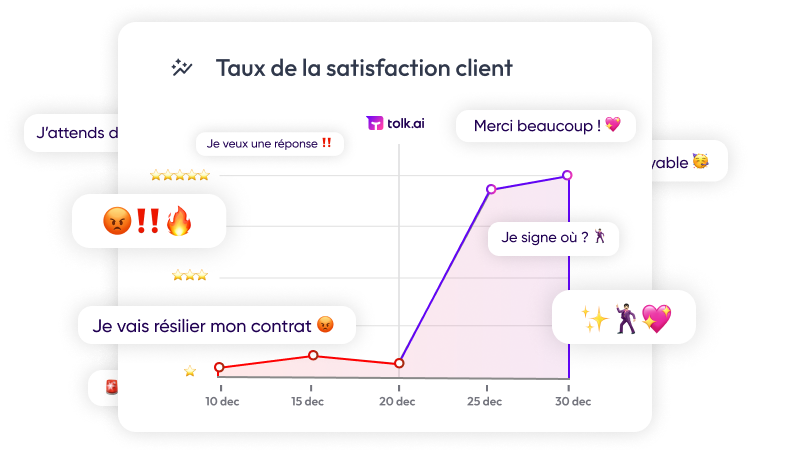
La transformation du métier d’agent de service client est amorcée depuis plusieurs années. Tous les signaux indiquent une évolution du rôle des agents et surtout une plus grande complémentarité entre l’humain et l’IA. En effet, selon une étude menée par Gartner, les entreprises qui utilisent des chatbots et d’autres formes d’IA pour le service client constatent une augmentation de 25 % de la satisfaction client.
Cependant, cette satisfaction client est encore plus élevée lorsque l’IA est utilisée en combinaison avec des agents humains. On mesure une augmentation de la satisfaction client de 35 % en moyenne. C’est le cas d’entreprises qui utilisent les solutions tolk.ai comme Aéroport de Marseille Provence, la Régie des Eaux d’Azur, Agorastore ou FMA Assurances.
Les bénéfices de l’IA dans la productivité des agents de service client 💪🏼
L’utilisation de l’IA dans les centres de relation client peut également augmenter la productivité des agents.
Selon une étude menée par Salesforce, 72 % des agents de service client disent que l’IA leur permet de se concentrer sur des tâches plus complexes, mais de se débarrasser des tâches répétitives. Mais l’IA peut aussi aider à réduire le temps de formation des agents, qui peut prendre jusqu’à six mois.
Comment ? En automatisant certaines tâches répétitives, en leur apportant des informations crutiales au bon moment ou en générant des réponses précises issues d’immenses bases de connaissances non-structurées.
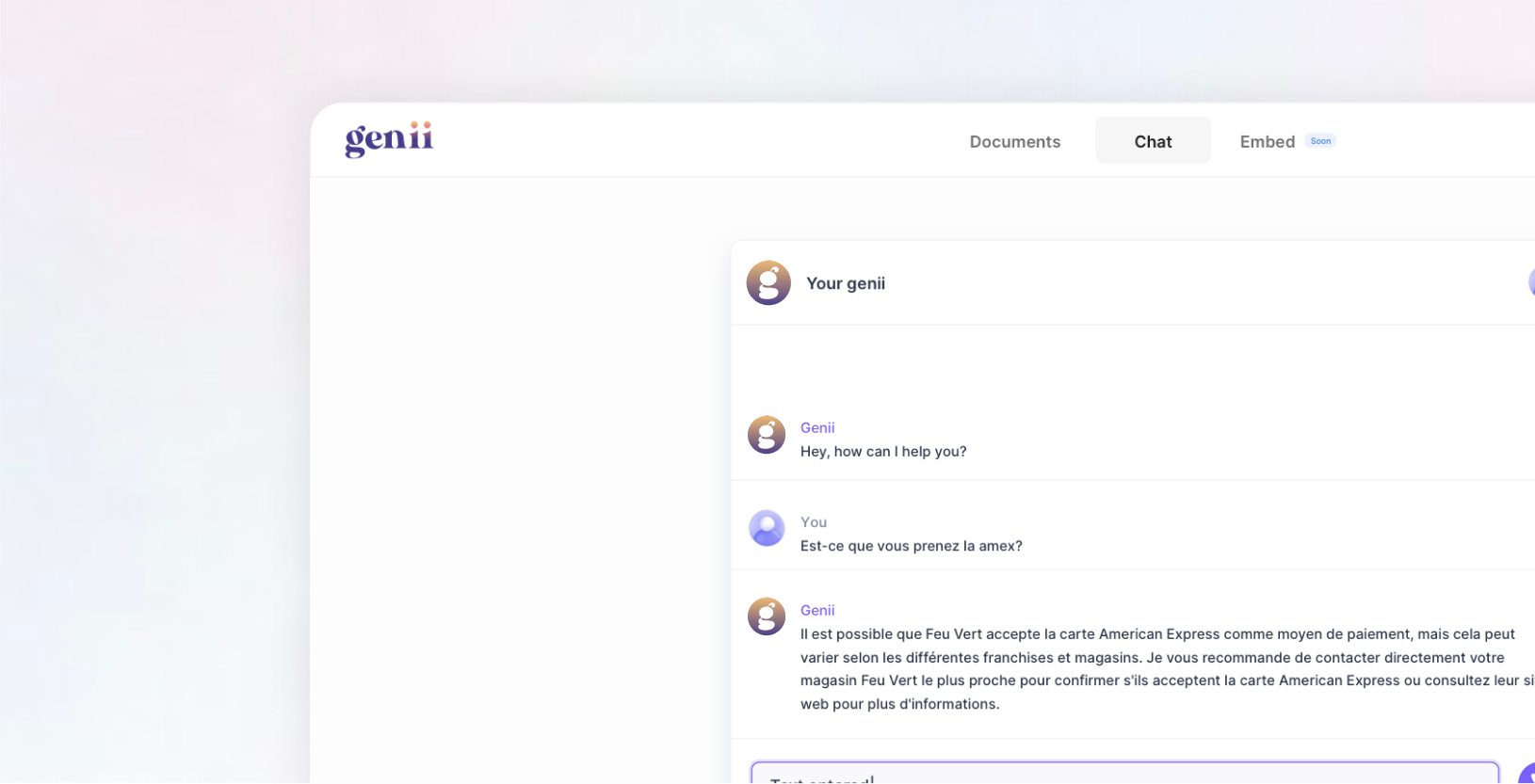
C’est cette innovation que porte tolk.ai avec Genii. Capable d’apprendre plusieurs milliers de pages de connaissances non-structurées (pdf, word, site internet, excel, …), Genii répond à toutes les questions de ses utilisateurs à partir des données avec lesquelles il a été entrainé.
Cette technologie très innovante promet de réduire encore le temps de réponse. Mais aussi d’améliorer l’expérience client. C’est aussi le début d’une nouvelle complémentarité entre les agents d’un coté et les intelligences artificielles de l’autre. Ces dernières permettent de raccourcir les cycles d’amélioration et de faciliter la formation des agents. Ce qui aura pour effet à moyen terme d’améliorer l’épanouïssement au travail et de réduire le turnover interne 🙌🏼
L’IA n’est pas miraculeuse mais pratique ✨
Passée l’excitation médiatique autours des dernières innovations en terme d’intelligence artificielle, il est important de comprendre que les intelligences artificielles ne sont utiles que quand elles sont correctement positionnées, alimentées avec des données pertinentes et calibrées pour intervenir dans un contexte défini.
Pour maximiser les bénéfices de la collaboration entre l’humain et les IA, les entreprises doivent fournir aux agents des outils conçus pour leurs besoins spécifiques. Et les alimenter avec des données cohérentes, propres et les plus structurées possible.
Selon une enquête menée par Accenture, 61 % des agents de service client estiment que les outils qu’ils utilisent ne sont pas adaptés à leur travail. Cela peut entraîner une diminution de la productivité, de la satisfaction au travail et de la qualité du service clientèle. Le triptyque FOD (Formation, Outils, Données) est au centre de la réussite d’un projet d’implémentation d’une IA dédiées aux agents.
Prenons l’exemple des dernières IA génératives, plus précisémment des modèles LLM dont GPT-4 est le représentant le plus en lumière en ce moment.
Ces modèles d’IA générative peuvent paraitre très efficaces et hyper performants, presque magiques. En réalité, il sont très utiles pour certaines tâches. Mais il est important de comprendre leurs limites dans certaines situations. Dans le cas d’une entreprise qui souhaiterait améliorer la productivité de son service client ou automatiser une grande partie des intéractions, des dangers existent. Ces modèles dit « généralistes » n’ont pas ingéré la connaissance métier nécessaire à une telle utilisation. Il est donc nécessaire de s’appuyer sur des outils et des modèles adaptés, entrainés sur les données de l’entreprises et « fine-tuned » pour répondre aux exigences de cette dernière.
L’agent augmenté n’en est qu’à ses débuts…
En conclusion, l’agent augmenté est une tendance qui gagne en popularité dans les centres de relation client des entreprises, grâce à ses avantages en termes de satisfaction client et de productivité.
Néanmoins, pour en tirer le meilleur parti, les entreprises doivent fournir aux agents des outils conçus pour leurs besoins spécifiques et des IA alimentées par des données de l’entreprise, afin de garantir une expérience client de qualité et et fidéliser ses agents de service client.