
Today, companies are deploying considerable resources to excel in customer experience. They are increasingly using artificial intelligence (AI) to manage their client interactions, and this trend is accelerating. One of the most innovative solutions is the “augmented agent”.
The promise? To be able to combine human skills with the efficiency of AI to improve the effectiveness of customer service ✨
AI is not the solution to all your challenges 👀
With the advent of new technologies and the recent advances in artificial intelligence, companies face new challenges. To modernize and meet their clients’ expectations, they must:
🎲 Adapt their processes and working methods.
Digitalization often involves changes in ways of working and communication methods. Customer service teams must adapt to these changes to be effective and productive.
🤯 Manage the complexity of omnichannel.
This can complicate client interactions due to the number of available channels (email, chat, social media, …). Companies must be able to guarantee a consistent and equally high-quality experience across all channels.
🔒 Ensure data security.
Digitalization leads to increased risks for data and infrastructure security. Companies must put in place robust security measures and continuously evolve them to maintain their clients’ trust.
🧞 Find the right tools.
There are many options and they are often very uneven in quality. Companies must find the tools best suited to their needs, budget, and existing infrastructure to deliver on their customer experience promises.
💪🏼 Train employees.
The digitalization of processes and methods can create new training needs. Mastery of new tools and work processes is key to ensuring the best agent productivity. Investing in human resources training ensures they are always capable of meeting client needs. Artificial intelligence promises to play a decisive role in the skills development of agents, as well as in facilitating their adaptation to ever-faster changes.
In summary, the digitalization of customer service offers many advantages, but also represents a significant challenge for companies.
To succeed in this transition, companies must be prepared to adapt to new working processes, manage the complexity of client interactions, ensure data security, find the right tools, and train their staff.
AI, like many other innovations, makes it possible to achieve certain objectives once it is used in a favorable context and correctly positioned.
The augmented agent: trend or utopia? 🤔
That is the promise of AI: to enable companies to embrace rapid digitalization by facilitating transformations over short cycles.
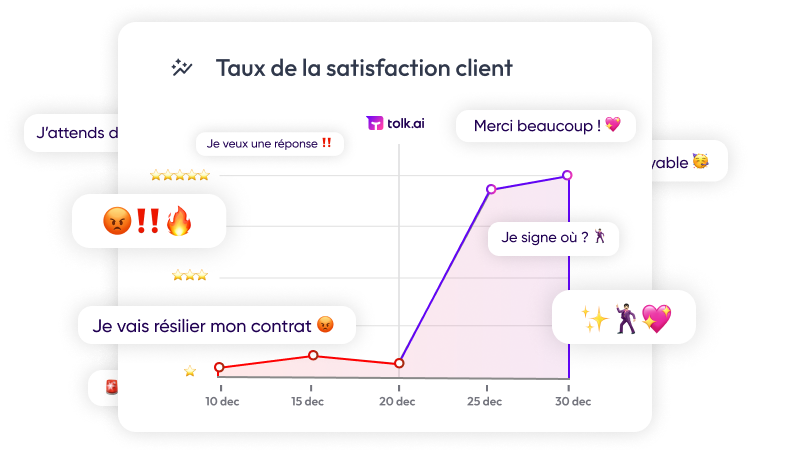
The transformation of the customer service agent role has been underway for several years. All the signals point to an evolution of the agent’s role and, above all, a greater complementarity between humans and AI. Indeed, according to a study by Gartner, companies that use chatbots and other forms of AI for customer service see a 25% increase in customer satisfaction.
However, customer satisfaction is even higher when AI is used in combination with human agents. An average 35% increase in customer satisfaction is measured. This is the case for companies using tolk.ai solutions such as Marseille Provence Airport, Régie des Eaux d’Azur, Agorastore, and FMA Assurances.
The benefits of AI on customer service agent productivity 💪🏼
The use of AI in customer service centers can also increase agent productivity.
According to a study by Salesforce, 72% of customer service agents say that AI allows them to focus on more complex tasks while eliminating repetitive ones. AI can also help reduce agent training time, which can take up to six months.
How? By automating certain repetitive tasks, providing agents with crucial information at the right moment, or generating precise responses from vast unstructured knowledge bases.
This is the innovation that tolk.ai delivers with Genii. Capable of learning from thousands of pages of unstructured knowledge (PDF, Word, websites, Excel, …), Genii answers all users’ questions based on the data it has been trained on.
This highly innovative technology promises to further reduce response times and improve the client experience. It also marks the beginning of a new complementarity between agents on one side and artificial intelligence on the other. AI shortens improvement cycles and facilitates agent training, which will, over the medium term, improve job satisfaction and reduce internal turnover 🙌🏼

AI is not miraculous, but it is practical ✨
Beyond the media excitement surrounding the latest AI innovations, it is important to understand that artificial intelligence is only useful when correctly positioned, fed with relevant data, and calibrated to operate within a defined context.
To maximize the benefits of human-AI collaboration, companies must provide agents with tools designed for their specific needs, and feed them with data that is consistent, clean, and as structured as possible.
According to an Accenture survey, 61% of customer service agents believe the tools they use are not suited to their work. This can lead to decreased productivity, job satisfaction, and quality of customer service. The FOD triptych (Training, Tools, Data) is central to the success of any AI implementation project dedicated to agents.
Take the example of the latest generative AI models, more specifically LLM models of which GPT-4 is currently the most prominent representative.
These generative AI models can appear highly effective and hyper-performant, almost magical. In reality, they are very useful for certain tasks. However, it is important to understand their limitations in certain situations. For a company that wants to improve the productivity of its customer service or automate a large portion of interactions, risks exist. These so-called “generalist” models have not absorbed the domain-specific knowledge required for such use. It is therefore necessary to rely on adapted tools and models, trained on company data and fine-tuned to meet the company’s specific requirements.
The augmented agent is only just beginning…
In conclusion, the augmented agent is a trend gaining popularity in corporate customer service centers, thanks to its advantages in terms of customer satisfaction and productivity.
However, to get the most out of it, companies must provide agents with tools designed for their specific needs and AI systems fed with company data, in order to guarantee a high-quality client experience and retain customer service agents.


