Conversational AI is now establishing itself as a structural lever for customer service. Long reduced to “simple” chatbots, it has evolved deeply to meet ever higher customer expectations around speed, personalization, and continuity of exchanges.
In a context of growing pressure on support teams, understanding what conversational AI really covers is becoming a strategic issue for online retailers.
This article offers a clear, structured reading of conversational AI applied to customer service: its foundations, how it differs from traditional approaches, the possible levels of maturity, and the changes it brings to support service strategy.
The Context: A Customer Service Under Pressure
Customer service teams face a combination of structural challenges:
The Inability to Scale
The impossibility of hiring fast enough to keep up with the explosion in request volume.
Data Fragmentation
Customer information scattered across the CRM, logistics, and emails, making resolution slow.
The Demand for Availability
The difficulty of responding instantly, around the clock, without sending operational costs soaring.
The Loss of Meaning at Work
People worn out by repetitive tasks, driving high turnover.
Request volumes are rising, channels are multiplying, and user journeys are growing more complex. At the same time, customers expect immediate, consistent, and personalized responses, whatever the point of contact. Traditional models, largely dependent on human teams and sequential processes, struggle to absorb this pressure without degrading service quality. Wait times grow longer, responses lack consistency, and agents are tied up with repetitive, low-value tasks.
In this context, AI customer service is no longer a matter of experimentation. It stands as a structural answer that reconciles volume absorption, quality requirements, and operational control.
Conversational AI: A New Approach to Customer Service
Conversational AI brings together a set of technologies able to understand, interpret, and produce natural language, both written and spoken. It draws in particular on natural language processing, machine learning, and, more recently, generative AI.
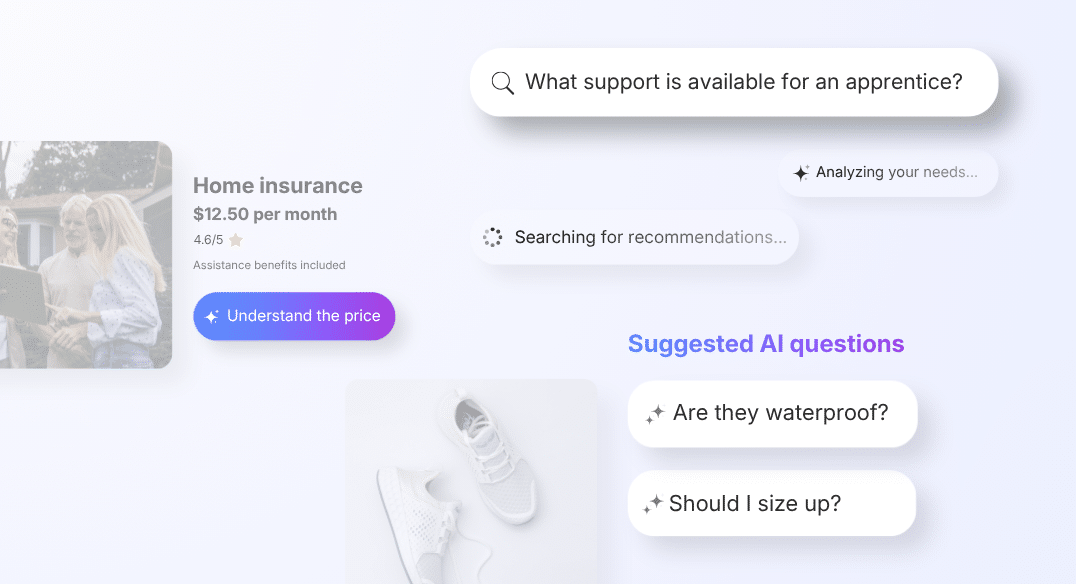
Applied to customer relations, conversational AI is not limited to providing automatic answers. It aims to understand a user’s real intent, to maintain the context of an exchange, and follows a logic of complete resolution rather than simple routing.
For example, conversational AI can identify the underlying goal behind a customer question whatever its phrasing (spelling, syntax, and so on) and respond in a suitable way.
Chatbots and AI Agents: Understanding the Difference
The distinction between a chatbot and a conversational AI agent is central to understanding what is at stake in AI customer service. Traditional chatbots generally rely on predefined rules and closed scenarios. Their effectiveness is limited as soon as the request falls outside the expected framework!
Conversational AI agents, on the other hand, are designed to handle dynamic conversations. They understand varied phrasing, keep context across several exchanges, and can interact with business systems to deliver contextualized responses.
This difference has concrete implications. Where a chatbot can point a customer to a FAQ, an AI agent can analyze a situation, cross-reference several sources of information, and guide the user all the way to resolving their request. It is this capability that marks the shift from basic automation to genuine conversational intelligence.
The Maturity Levels of AI-Assisted Customer Service
Moreover, AI adoption does not happen in a single day. It follows a maturity curve where each stage brings exponential added value, turning the cost center into a strategic lever.
Level 1: Conversational AI
At this stage, AI relies on natural language understanding (NLU). It goes beyond the simple choice button to interpret precise intents:
- Answering frequently asked questions (FAQs),
- Qualifying the request,
- Smart routing to the right advisor.
In short, the direct gain is an immediate easing of queues on low-value requests.
Level 2: Generative AI
Here, more capabilities tied to Large Language Models (LLMs) are generally integrated. AI no longer simply draws on pre-written answers; it generates fluid, nuanced, and empathetic responses:
- All the capabilities of Conversational AI,
- Natural rephrasing,
- Summarizing long documents,
- The ability to hold a dialogue without any “break” in understanding.
Ultimately, this enables a more human customer experience and a drastic reduction in the frustration tied to “rigid” bots.
Level 3: Agentic AI
The most advanced stage is that of Agentic AI. The AI agent is no longer merely a conversational partner, it is a doer. It has the reasoning autonomy to carry out complex tasks from end to end:
- All the capabilities of Conversational AI,
- All the capabilities of Generative AI,
- Deep connection to the CRM and business tools (ERP, logistics).
Indeed, AI can then cancel an order, change a booking, or trigger a refund by following strict, predefined business rules.

To go further:
To deepen these concepts, you can consult the reference analyses on the evolution of customer relations:
- Gartner: The firm details the emergence of Agentic AI as a major technology trend.
- HubSpot: An excellent analysis of the shift from the traditional chatbot to conversational AI for marketing and service.
Artificial Intelligence: A Defining Choice for the Years Ahead
AI transforms support strategy beyond the technology itself. It reshapes the distribution of roles, operational priorities, and the way performance is measured. Human teams focus more on complex, sensitive, or high-value situations.
Ultimately, AI takes on the repetitive interactions while ensuring consistency of response across every channel.
This shift fosters a more holistic view of customer service. A view in which performance rests on the quality of resolution, the continuity of exchanges, and the ability to adapt to user needs.
It thus becomes a lever for lasting transformation, at the heart of the customer relationship strategy.
Conclusion
In conclusion, AI in the service of customer support is not just about automating exchanges. It embodies a deep evolution of support models, grounded in language understanding, context, and the ability to resolve complex requests at scale.
It also meets the needs of ever more demanding and connected consumers. For companies, the challenge is therefore to adopt this technology gradually and in a structured way, taking into account their level of maturity and their business goals.
It is on this condition that artificial intelligence becomes a true driver of quality, consistency, and customer service performance.