A chatbot, in the broadest sense of the term, is a virtual assistant deployed on a website or messaging application (Messenger, Whatsapp, ...), capable of managing a conversation in natural language or at least a guided tree structure.
There are two families of chatbots: dumb bots and NLP chatbots.
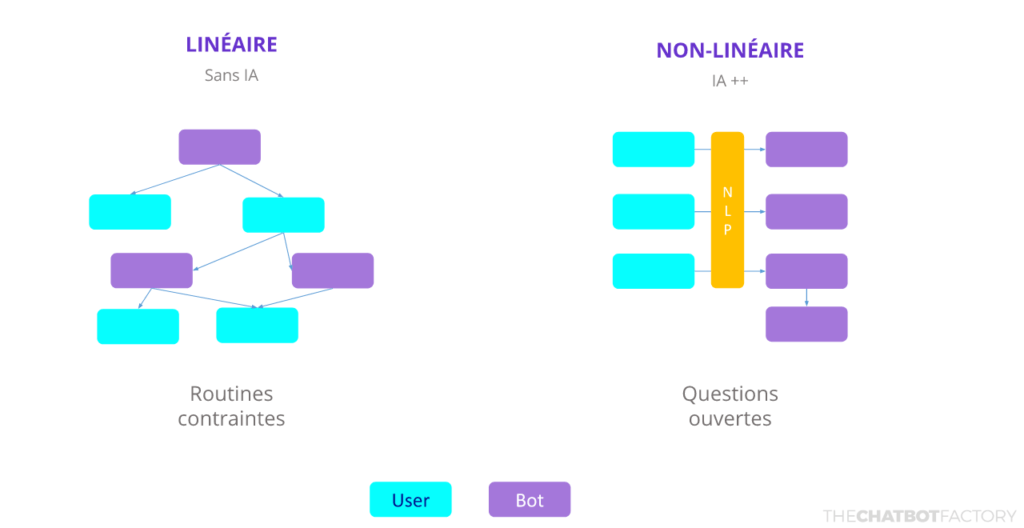
Dumb bots: linear chatbots
Tout d’abord, les chatbots linéaires reposent sur des arbres de décision prédéfinis. L’expérience utilisateur séquencée par étapes, s’enchainant mécaniquement et permettant une navigation dans une arborescence plus ou moins complexe. Pas d’intelligence, l’expérience utilisateur est similaire à une navigation dans une interface graphique.
Advantages:
- closed courses, few mistakes possible,
- easy to build in POC format
Disadvantages:
- difficult to scale,
- unsuited to "customer service" uses-cases, as it is difficult to manage rich knowledge bases,
- the need to rethink the entire itinerary in the event of changes to all or part of the scope,
- no listening to customer requests or collecting customer verbatim.
NLP Chatbots or Virtual Assistants
À l’inverse, un chatbot NLP comprend l’intention utilisateur et adapte sa réponse en temps réel.
Still not widely used, they suffer from a tarnished image due to the difficulties involved in setting them up and their often less-than-stellar performance.
Since 2016, when automated natural language processing technologies first emerged, their performance and reliability have continued to improve. At The Chatbot Factory, we set about developing our own NLP technologies with the ambition of simplifying their deployment by non-techs and improving their ROI.
Les chatbots NLP sont les agents virtuels les plus performants sur le marché ! Fluides, libres et « intelligents », les agents conversationnels dopés à l’IA sont les plus similaires à l’humain.
Nevertheless, they can be complex to implement. They are based on machine learning technologies that require large amounts of available, structured data.
Dans ce domaine, la plateforme tolk.ai (développée par les équipes de The Chatbot Factory) innove en mêlant deux approches de traitement automatisé du langage naturel. L’approche sémantique et l’approche machine learning. Elles se complètent parfaitement dans l’objectif de délivrer des performances dès les premiers jours d’exploitation du chatbot, en garantissant une montée en puissance au fur et à mesure que le chatbot se nourrit des données de conversation générées.
Advantages :
- no decision trees to constrain the experiment,
- speed of demand resolution,
- the possibility of linking to other themes or related content,
- user experience close to a "human" conversation,
- flexibility in the evolution of courses and knowledge bases,
- listening to customer questions,
- escalation to an intelligent, dynamic agent,
- ability to respond in a personalized way,
- higher levels of user satisfaction.
Disadvantages :
- out-of-scope more frequently,
- choice of technology (prefer hybrid models),
- in performance management.
The ++ Tolk :
- Hybrid NLP technologies,
- Set up in 1 to 2 hours from a FAQ,
- Native and automatic disambiguation,
- Generation of automatic and dynamic training data sets,
- Self-assessment of model performance for continuous optimization.
Why launch your chatbot?
Ainsi, les chatbots NLP s’imposent comme une solution stratégique pour automatiser les demandes complexes. Aujourd’hui, les attentes des consommateurs et leurs usages ont fortement évolués pour se déporter vers des environnements digitaux. Le messaging, Chat ou autres messageries instantanées ont colonisé notre quotidien. A titre personnel ou dans l’univers professionnel, les échanges s’organisent de plus en plus sur ces plateformes.
Use cases for NLP chatbots are numerous, but most often crystallize around 2 functional verticals:
- customer service - automatically answer recurring user questions, automate business processes and manage complex recurring requests (requiring CRM integrations),
- lead capture - capturing and qualifying sales opportunities, then intelligently directing them to the right contact for processing.
To maximize the ROI of such projects, you need high-performance technology, easy-to-use tools that guarantee the bot's evolution, and a team of business experts who are properly trained and continually involved to maximize customer satisfaction and the virtual agent's performance.